Newsweek: America’s collapse has just begun!
Fifteen years ago, amid the rapid rise of social media and the slow recovery from the Great Recession, and precisely in the middle of US President Barack Obama’s term, a University of Connecticut professor warned that the United States was heading into a decade of increasing political instability.
At the time, this warning seemed counterintuitive… The global economy was recovering from the financial crisis, and the American political system was still experiencing post-Cold War optimism despite the cracks that had begun to appear within it.
According to Newsweek, as Peter Turchin, an environmentalist turned historian, had a different opinion based on his data.
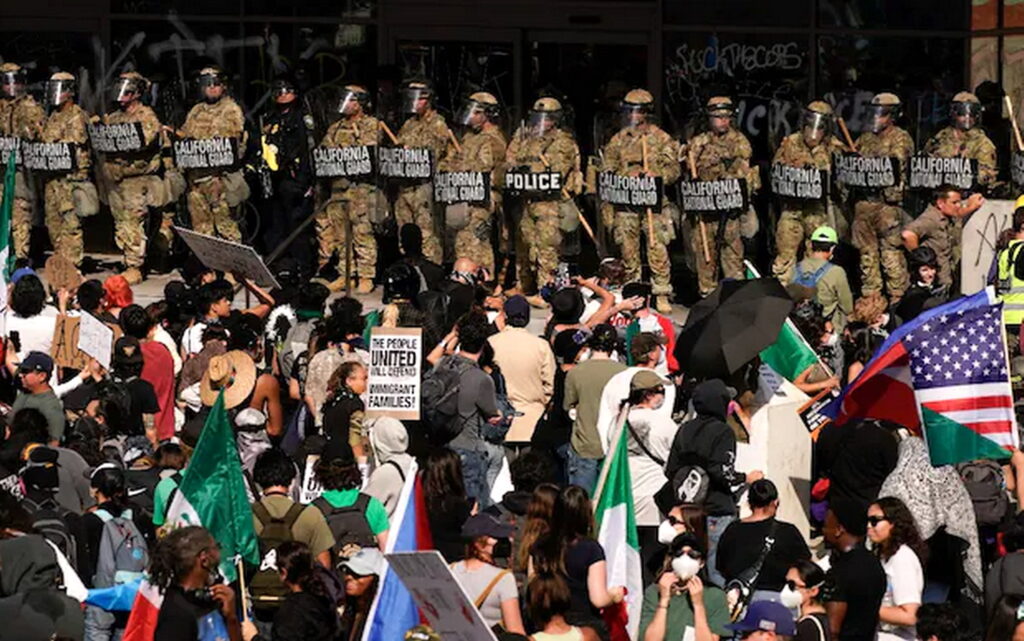
The Newsweek interviewed him in the wake of escalating protests and the deployment of National Guard troops in Los Angeles amid President Donald Trump’s crackdown on immigrants.
Turchin’s predictions about what would happen appeared to be surprisingly accurate.
In an analysis published in the journal Nature in 2010, Turchin identified several warning signs, including stagnant wages, a growing wealth gap, a surplus of educated elites without matching jobs for their qualifications, and a rapidly growing fiscal deficit. He argued that all of these phenomena reached a tipping point in the 1970s.
Turchin based his predictions on a framework known as demographic structural theory, which models how historical forces—manifested by economic inequality, elite competition, and state power—interact to drive cycles of political instability.
In the interview, Turchin, now a professor emeritus at Yukon University, said that nearly every one of these indicators has worsened, pointing to the virtual stagnation of wages, the impact of artificial intelligence on the professional class, and increasingly uncontrollable public finances.
The historian argues that violence in the United States tends to recur approximately every 50 years, pointing to bouts of unrest in 1870, 1920, 1970, and 2020.
He adds that one of the clearest historical parallels to what is happening now is the 1970s.
That decade saw the emergence of radical movements from college campuses and middle-class enclaves, not only in the United States but throughout the West.
Turchin told the Newsweek that in 2010, he had predicted that the United States would experience a period of three-dimensional political instability at the beginning of the 21st century, driven by worsening popular poverty, overproduction by elites, and weakening state capacity.
According to his model, Trump’s rise was not the cause of America’s political crisis, but rather a symptom of a society already strained by widening inequality and a state saturated with elites.
In Turchin’s view, figures like Trump often arise when a growing class of counter-elites, composed of ambitious and qualified individuals who are isolated from power, begins to challenge the status quo.
“Competition among elites has increased even more, now driven largely by the shrinking supply of positions for them,” he said.
This theory was echoed by Wayne State University sociologist Jukka Savolainen, who argued in a recent opinion piece in the Wall Street Journal that the United States risks creating a radical intellectual class made up of highly educated individuals who have been excluded from state institutions.
Savolainen warned that Trump-era policies—such as dismantling diversity, equity, and inclusion programs, academic research, and shrinking public institutions—could accelerate the unrest of the 1970s.
He noted that President Trump’s policies could exacerbate this dynamic.
Turchin, for his part, believes that the American system has entered what he calls a “revolutionary state,” a historical phase in which state institutions, through their mechanisms and systems, can no longer contain destabilizing conditions.
Turchin concluded by saying that all these indicators are, unfortunately, gaining increasing momentum.