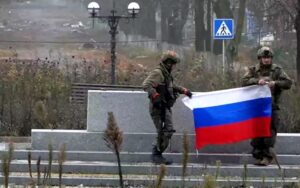
New York Times: An increase in Russia’s control over lands in the Donbas region

The New York Times revealed that the territory gained by Russia since the beginning of this year in the special operation area amounted to more than 857 square kilometers, while Ukraine gained 370 square kilometers.
According to the New York Times, Ukraine has aspired since the beginning of 2023 to divide the Russian forces by launching an attack in the southern regions, which it failed to do and didn’t go as planned.
It didn’t succeed in changing the front line after months of fierce fighting and heavy losses.
According to a New York Times analysis of data from the Institute for the Study of War, “While Ukraine made small gains in the south, Russia controlled larger swaths of territory overall, much of it in the northeast”.
On the other side of the front line, every mile of territory was a grinding battle for Ukrainian forces that failed to make a rapid breakthrough.
The experienced Ukrainian soldiers and commanders who were killed earlier in the military operation were replaced by new recruits who lacked sufficient training.
The New York Times explained that the Ukrainian counterattack is facing difficulties in advancing across wide-open fields in the south, as it faces extensive minefields and hundreds of miles of fortifications, anti-tank trenches, and concrete obstacles that Russian forces built last winter to defeat Ukrainian vehicles and force them to take positions in which they can be targeted more easily.
The New York Times also revealed that Russia now controls approximately 518 square kilometers of territory compared to the beginning of the year.
According to Dr Marina Miron, a researcher in war studies at King’s College London, instead of seeking quick gains, the Russian army seems comfortable with retaining the lands it already controls, noting that the Russian army does not lose anything by not advancing.
She added, “The strategy followed by the Russian army is to allow the Ukrainians to attack the defenses that were built along the front line, kill as many of them as possible, and destroy as much Western military equipment as possible”.
The New York Times pointed out that slowing down the counterattack comes with great risks for Kiev, and if it seems unlikely that it will be able to regain large areas of the country, Western support may diminish, either due to a lack of political will or an unwillingness to provide more weapons, Especially in light of the long wait for delivery of replacement equipment.
Meanwhile, time is running out for the counterattack launched by Ukraine to achieve significant territorial gains, and heavy rains are expected next month, as the muddy terrain will prevent the use of heavy vehicles, such as the newly arrived US Abrams tanks and the Challenger tanks that have arrived.
According to Dr. Miron, “When there is mud and you have a 75-ton Challenger tank, it will sink”.
The Ukrainian counter-attack began on June 4, when Kiev deployed brigades trained by NATO and carrying Western weapons, including Leopard tanks, which were widely deployed on the battlefield.
It then took snapshots of a number of burning military vehicles in the area.
The battlefield caused a wide resonance in the West.
For his part, Russian President Vladimir Putin said, last July 21, that there are no results for the Ukrainian forces, and Western leaders are clearly frustrated with the course of the counterattack, as neither the enormous resources that were pumped there nor the supply of weapons helped Ukraine.
Tanks, artillery, armored vehicles and missiles, and sending thousands of mercenaries and advisors.