Maariv: Egypt and Syria are losing Israel to its most prominent centers of power with Saudi support
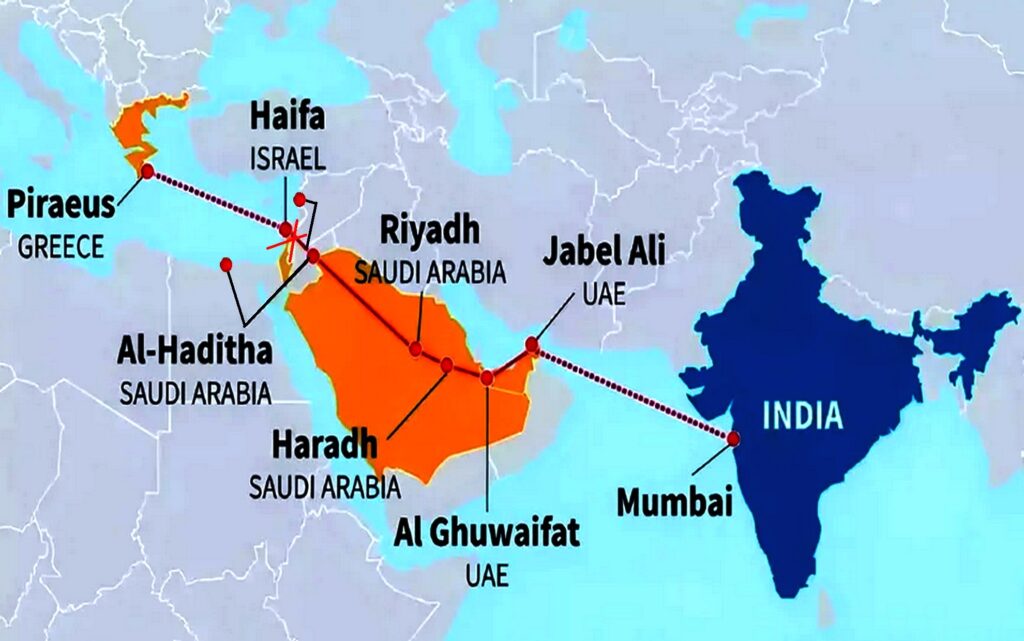
Israel’s Institute for Maritime Policy and Strategy has warned that Israel’s non-participation in the India-Middle East-Europe Economic Corridor (IMEC) initiative constitutes one of the most serious strategic failures the country has faced over the past ten years.
According to Maariv newspaper, this broad geopolitical initiative is led by the United States, India, Saudi Arabia and the United Arab Emirates, along with the European Union, and aims to create an alternative network to China’s Belt and Road project by connecting Asia to Europe with an integrated system that includes transportation, energy, and communications.
The official announcement of the project took place during the G20 summit in New Delhi in September 2023, where the port of Haifa was initially envisioned as a major focal point in the Eastern Mediterranean.
The landscape later changed, however, as Israel remained out of the core memorandum of understanding, while Gulf states — with talk of Saudi support — move to develop ports in Syria, while Egypt moves ahead with new logistics networks that connect Red Sea ports to modern railways that bypass Israeli territory entirely.
Maariv explained that the risks are no longer hypothetical, but are tangible on the ground, with Emirati and European companies entering into projects to modernize the ports of Tartus and Latakia, while Cairo is working to redraw regional trade routes through corridors that don’t pass through Israel.
The institute warned that the continuation of this trend could lead to far-reaching consequences, including the decline of the status of the ports of Haifa and Ashdod as regional logistics hubs, the diversion of international trade lines and energy and telecommunications projects to alternative routes, in addition to the possibility of Israel being exposed to economic and structural isolation in a region that is witnessing the expansion of modern transportation networks and clean energy.
Maariv newspaper quoted the head of the institute, Prof. Rear Admiral (Ret.) Shaul Chorev, as saying that the repercussions of this failure could be severe for national security, noting that a break from the global green energy and hydrogen grids would weaken Israel’s connection to Europe and the United States, and could have economic effects that span generations.
Chorev called on the Israeli government to move quickly through a contingency plan that includes formal accession to the Memorandum of Understanding on the Economic Corridor, accelerating the rail link project with Jordan and Saudi Arabia, known as the “Peace Rails”, as well as establishing a free trade zone with Jordan and developing Haifa Bay into a global logistics hub.
Maariv stressed that the project goes beyond being a transportation infrastructure, but rather represents a restructuring of the regional and international balance of power, and that Israel’s absence from it may mean missing a strategic opportunity to strengthen relations with Saudi Arabia and the countries of the Abraham Accords under the auspices of the United States.
The report concluded by warning that the available time is rapidly shrinking, and that Israel must make a decisive decision between playing a pivotal role in future global trade or facing a gradual strategic decline at a time when neighboring countries are stepping up to fill the geographic and economic vacuum.