Israeli report: Cairo strengthens its defenses in Sinai and simultaneously supplies the Arab Gulf states with Amoun systems
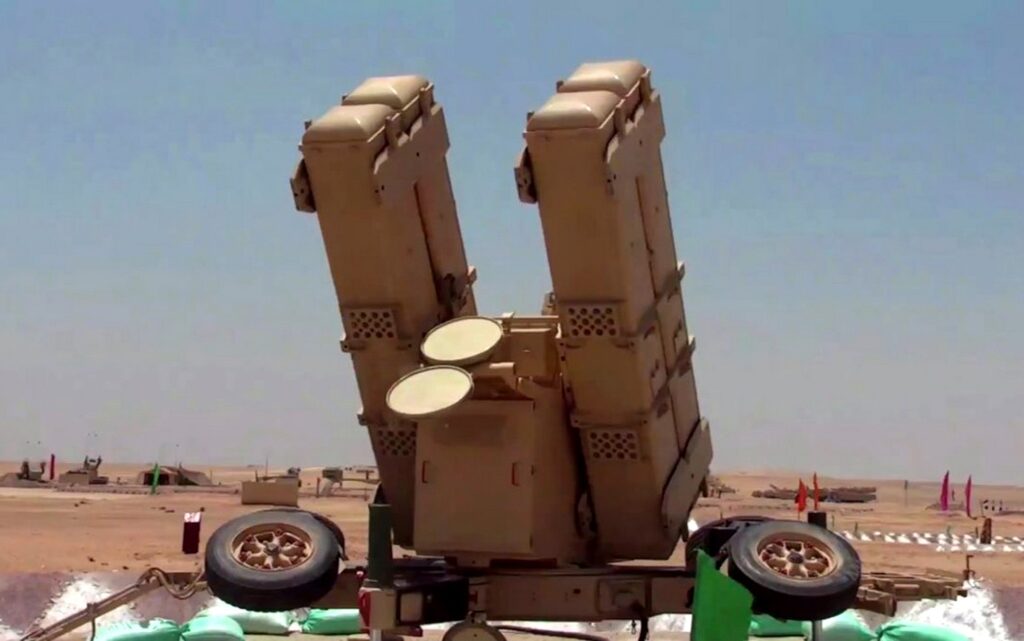
Israeli reports indicate that Egypt has strengthened its defense systems in Sinai to unprecedented levels, and sent other systems to the Gulf states without compromising its strategic capabilities.
According to Israeli news platform Natsiv Net, Egypt deployed defense systems in the Gulf states from the operational stock of its air defense arm, but the systems weren’t transferred from Sinai.
The report added that Egypt has in fact strengthened and reinforced its air defense system in Sinai to historic record levels in parallel with providing assistance to the Gulf.
The details regarding the current defensive deployment in Sinai compared to the deployment for the Gulf states up to April 2026 show that the situation in Sinai is being strengthened, not reduced.
While Amoun (Skyguard) systems were sent to the Gulf states, Egypt deployed its most advanced and strategic systems in Sinai.
The Chinese HQ-9P long-range systems (up to 300 km) were placed in the areas of Arish and Rafah.
These systems are equivalent in their capabilities to the Russian S-400 systems and create a defensive bubble that covers all of the skies of Gaza and southern Israel up to the Gush Dan area.
The report noted that an operational peak was recorded up to April 2026 with the deployment of about 40,000 soldiers in Sinai, along with advanced radar and electronic warfare systems, in the widest deployment since the 1979 peace agreement.
Natsiv Net said that the systems sent to Saudi Arabia and the UAE were taken from operational reserves for the defense of the Egyptian interior (inside the country and the canal area) and not from the front lines of defense in Sinai.
It added that Egypt was careful not to weaken its grip on Sinai, which it describes as the backbone of national security, during this period of regional tension.
The report indicated that the decision to use the Amoun systems stemmed from their suitability, especially for intercepting drones and cruise missiles – the central threat in the Gulf – while Egypt prefers to keep long-range systems in Sinai for strategic deterrence.
Egypt is now working on two parallel axes: in Sinai, its building an independent and massive deterrent capability while exceeding the military restrictions of the Camp David Accords under the pretext of the need to combat terrorism and protect borders, and in the Gulf, its projecting a regional power as a protector of Arab states, which gives it significant political and economic weight vis-à-vis Iran and Western countries.
The Skyguard Amoun Anti-Aircraft System is an Egyptian medium- and short-range air defense system that combines artillery and missiles, and is considered the Egyptian version of the Italian Skyguard system.
The system consists of two 35mm Oerlikon anti-aircraft guns, two rocket launchers (each launcher contains 4 AIM-7 Sparrow rockets), and a command and control center to manage operations and control the system.
The system is capable of engaging three aerial targets simultaneously using missiles and artillery, and was specifically designed to protect high-value assets such as airports, cities, and military installations.
The advanced Egyptian defense system is characterized by high effectiveness in intercepting drones and cruise missiles.
According to reports, the Egyptian Amoun defense system is manufactured by the Egyptian Arab Organization for Industrialization, which is affiliated with the Egyptian army, and represents the first medium-range air defense system of Egyptian production, as it was developed with a license and technical support from the Italian manufacturing company.
Egypt had offered the system to the United Arab Emirates and Saudi Arabia to counter air attacks, and Egypt possesses 72 units of the system distributed across 18 battalions.
The Amoun system is considered a powerful addition to Egyptian air defenses, and is distinguished by its special suitability for dealing with modern threats such as drones and long-range missiles, making it a key element in Egypt’s multi-layered air defense system.