Bloomberg: The German Bundestag to be shrunk as of the upcoming elections
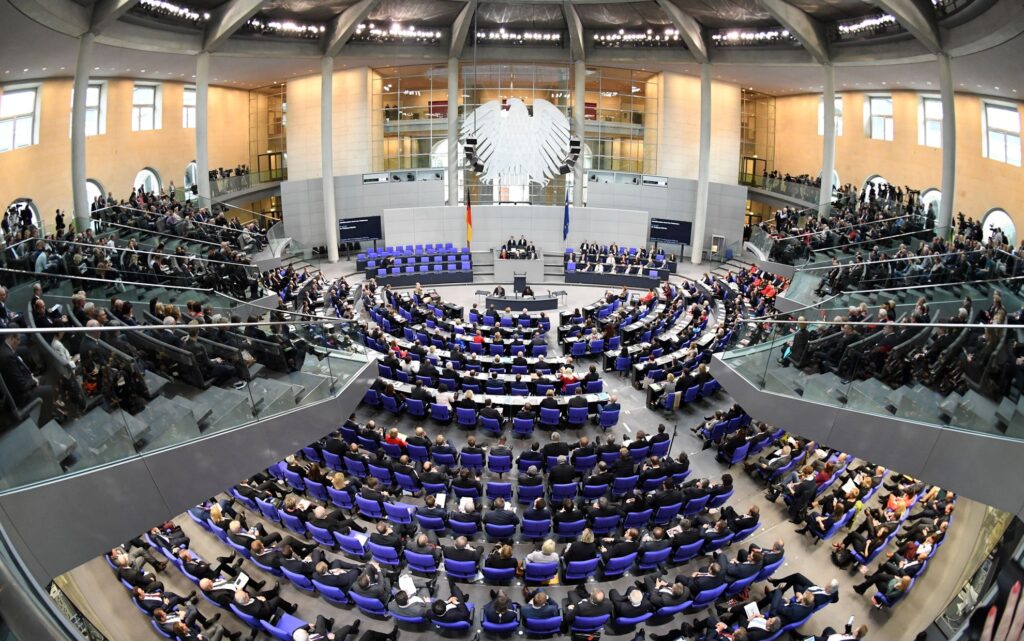
Germany’s 735-seat Bundestag, the world’s largest elected parliament, is set to shrink dramatically after Sunday’s election as part of a sweeping overhaul of the voting system that has been in the works since the last attempt failed five years ago.
Bloomberg reported that the difficulties facing reaching a consensus on reform reveal signs of divisions that may face the next government in its quest to revive Europe’s largest economy.
The current Bundestag has 23% more seats than its original 598, due to complex procedures aimed at balancing local representation and political support at the national level.
As a result, the costs of the lower house of parliament have risen to 1.24 billion Euros in 2024, an increase of nearly 25% over 2020.
These increased costs, resulting from hundreds of additional MPs, conflict with the need to reduce bureaucracy and simplify the decision-making process.
In the next election, the maximum number of seats in the Bundestag will be set at 630, while that represents progress, the number is still 32 seats more than the basic rule.
The reform legislation was partially amended by court order after being challenged by several parties, including the Christian Democratic Union, which leads in opinion polls, and the Left Party, which is seeking to maintain its position in the Bundestag.
That explains why the reforms have been so controversial; If the new rules had been applied to the 2021 elections, the Bundestag would have had 105 fewer seats.
The Bavarian Christian Social Union, a traditional ally of the Christian Democratic Union, was the most affected by these amendments, as it would have been deprived of 3 surplus seats, which had previously led to an imbalance in the distribution of seats.
When German voters go to the polls, they cast two votes: one to choose a local candidate, and the second to choose their preferred party.
It is these latter votes that ultimately determine the composition of the Bundestag.
For example, Olaf Scholz’s Social Democrats won the 2021 election with 25.7% of the second vote, beating the CDU/CSU alliance with 24.2%.
But because of the electoral system, some parties may win more seats than they have a share of the national vote.
These extra seats are known as surplus seats.
In 2013, balancing seats were introduced to compensate for this imbalance, giving them to other parties to achieve proportionality.
This means that the more seats there are, the more balancing seats are needed, resulting in an increase in the number of MPs during the last two elections.
In 2020, the government sought to reduce the number of seats by not compensating for up to 3 of the surplus seats, but the reform wasn’t fully successful, especially because the CSU won a large number of districts in Bavaria.
The 2023 Elections Law focuses on achieving proportionality in representation, as surplus seats and balance seats have been abolished, and local candidates will only be able to enter parliament if their party obtains enough votes to support this.
First, the government scrapped a provision that allowed parties to enter parliament if their candidates won in three or more constituencies, known as the basic mandate rule.
This amendment has drawn criticism from the Left Party, the Christian Democratic Union and the Christian Social Union, who consider it unfair to small parties.
In June 2024, the German Constitutional Court reinstated this rule for lack of a fairer alternative, resulting in the adoption of the current system.
That could be good news for some parties.
Recent polls show that the pro-business Free Democrats and the left-wing breakaway party of Sahra Wagenknecht may fall short of the 5% threshold needed to be represented in the Bundestag, but could still gain seats if they win at least three constituencies.
This is not unprecedented, as the Left Party managed to enter the Bundestag in 2021 despite receiving only 4.9% of the second votes.