Axios: Trump is considering taking control of Iranian oil on Kharg Island if he doesn’t open the Strait of Hormuz

Axios quoted US officials as saying that President Donald Trump’s administration is considering taking control of Iranian oil on Kharg Island if the Strait of Hormuz isn’t opened to navigation.
The US officials noted that implementing the move would require the presence of US boots on the ground, while a White House official confirmed that Trump hadn’t yet made a decision on it.
According to Axios, some officials believe that the control of the oil of Kharg Island could be a severe economic blow to Iran because it’s a major hub for its oil exports.
This comes as the UK’s Maritime Trade Operations Authority (UKMTO), part of the British Navy, announced that the danger still exists in the Strait of Hormuz, due to recent attacks, disruption to navigation, and ongoing operational disruptions, despite the fact that no incidents have been reported in the past three days.
At least 20 ships have been attacked in the vicinity of the Arabian Gulf, the Strait of Hormuz and the Gulf of Oman since the war began three weeks ago.
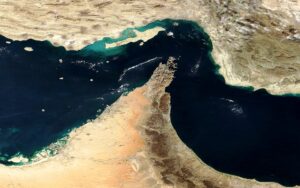
The Strait of Hormuz is about 212 kilometers long, about 33 to 55 kilometers wide, and 60 to 100 meters deep.
This makes the safe passage for navigation of large ships very narrow.
The strait connects the Arabian Gulf to the Gulf of Oman and the Indian Ocean.
Its bordered by Iran to the north, Oman’s Musandam Peninsula and the United Arab Emirates to the south.
The midline was adopted to divide its waters between countries.
As for navigation, it sees the passage of about 20 million barrels of oil per day, as well as a large portion of liquefied natural gas, urea, helium, and aluminum.
With the exception of Saudi Arabia, the UAE, Oman, and Iran itself, which have foreign ports, many countries need to pass through the strait for their foreign trade, as is Qatar, Kuwait, Iraq, and Bahrain.
As the US-Israeli war on Iran continues to stir up turmoil across the Middle East and global energy markets into its third week, Trump insisted on Sunday that countries heavily dependent on oil from the Gulf have a responsibility to protect the strait, through which 20% of the world’s energy passes.
Trump told reporters aboard the presidential plane en route to Washington from Florida: “I call on these countries to intervene and protect their territory, because it’s their territory… It’s where she gets her energy”.
Trump said his administration had already reached out to seven countries, but didn’t specify which countries.
In a social media post over the weekend, he expressed hope that China, France, Japan, South Korea, Britain and other countries would participate.