Financial Times: Japan just cannot say no to the US!
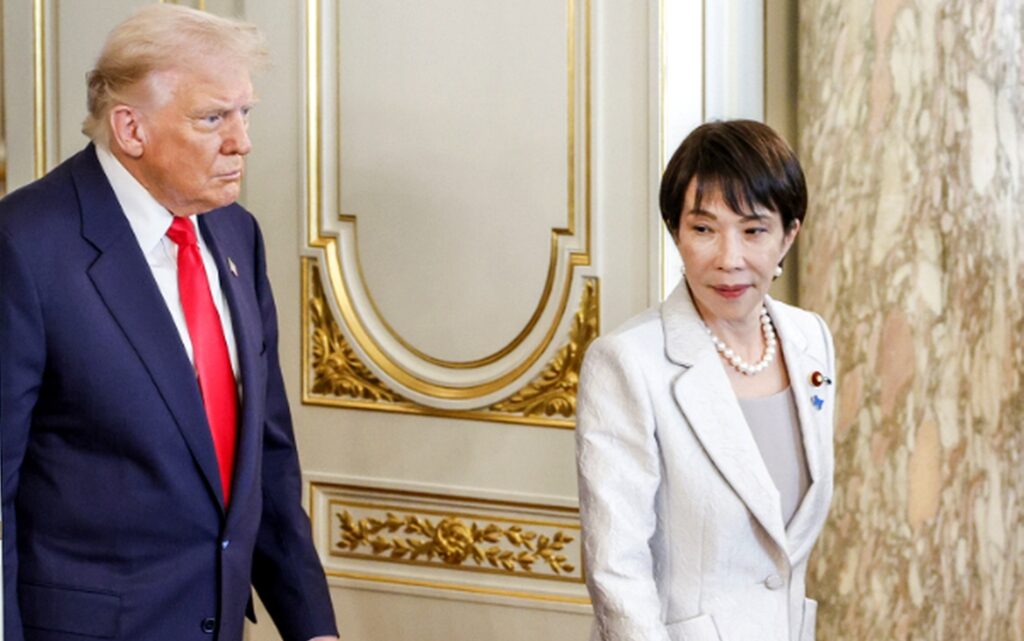
The Financial Times newspaper addressed the reality of the tense and increasingly complex relationship between Japan and the United States, with the return of US President Donald Trump to the White House with a more confrontational and volatile approach towards traditional allies.
Japan, despite being the world’s fourth-largest economy, seems unable to break free from its security and economic dependence on Washington, effectively making it a “country that cannot say no” to the United States.
When Trump publicly criticized Japan in a symbolic political incident, as he publicly criticized Japan for not supporting the United States in the context of tensions with Iran, despite the presence of more than 50,000 American soldiers on its territory.
Japanese Prime Minister Sanae Takaichi described the statement as reflecting the fragility of the relationship with the American ally, and confirming that Tokyo has become vulnerable to the whims of US politics, even on sensitive issues related to national security.
Japan faces a deeper strategic dilemma than its European counterparts because its constitution – drafted by the United States after World War II – limits its ability to use military force (Article 9), making it almost entirely dependent on the American security umbrella.
At the same time, regional threats to Japan are escalating from China, North Korea, and Russia.
This reality places it in a highly sensitive geopolitical position, and makes the search for realistic alternatives to the alliance with Washington extremely difficult.
On the economic front, trade relations between the two countries are no longer balanced.
Japan is under significant US pressure regarding tariffs, leading it to commit to massive investments in the United States, estimated at hundreds of billions of dollars, to avoid harsher trade penalties.
Some experts have described this situation as closer to “economic blackmail,” with Tokyo finding itself forced to make huge financial concessions to maintain the stability of its relationship with Washington.
Previous attempts to ease tensions between the two countries during Trump’s first term, when the late Japanese Prime Minister Shinzo Abe tried to correct Trump’s misinformation about Japanese regulatory restrictions on American cars.
Although Trump was convinced at the time that the test he spoke of didn’t exist, he returned to talking about it again after his return to the presidency, reflecting the instability of his worldview and the difficulty of predicting his policies towards allies.
In the security context, the article highlighted Japan’s concern about the possibility of a direct US-China rapprochement that could lead to a rearrangement of Washington’s priorities in Asia, potentially marginalizing Tokyo’s interests.
Decision-making circles in Japan fear a Group of Two (G2) scenario between the United States and China, which could weaken traditional alliances in the Indo-Pacific region and leave Japan alone to face its powerful neighbors.
Prime Minister Sanae Takaichi is attempting to pursue a dual strategy:
The first axis: Maintaining the alliance with Washington through a flexible diplomatic policy based on flattery, investment, and economic concessions.
The second focus: Searching for future options that reduce absolute dependence on the United States after the end of Trump’s term.
This approach was partially successful in avoiding additional military demands during her meetings with Trump, but it did not dispel long-term concerns.
The escalating internal debate in Japan about the need to diversify international alliances, or even to build a bloc of middle powers (Japan, Australia, India, and South Korea) to counterbalance American and Chinese influence.
However, most analysts agree that the alternatives are very limited because Japan’s sensitive geographical location, and its historical dependence on American protection, as the Japanese constitution (Article 9) restricts its strategic options.
Despite attempts to amend and flexibly interpret this constitution, the transition towards full defense independence still requires profound and long-term changes that are difficult to achieve in the near future.
Tokyo’s options are limited to managing fluctuations and remaining dependent, as Japan – despite its attempts to modernize its defense and economic policies – remains confined within the framework of an unequal relationship with the United States, where it’s difficult for it to find a real Plan B.
Therefore, Tokyo’s options remain practically limited to strengthening its alliance with Washington and attempting to manage its fluctuations rather than breaking free from it.
This makes the idea of a “Japan that can say no”—which was strongly promoted in the 1990s—more of a historical symbol of an unfulfilled ambition than a realistic option in 2026.