Macron is facing a political dilemma after the possible fall of Bayrou’s government
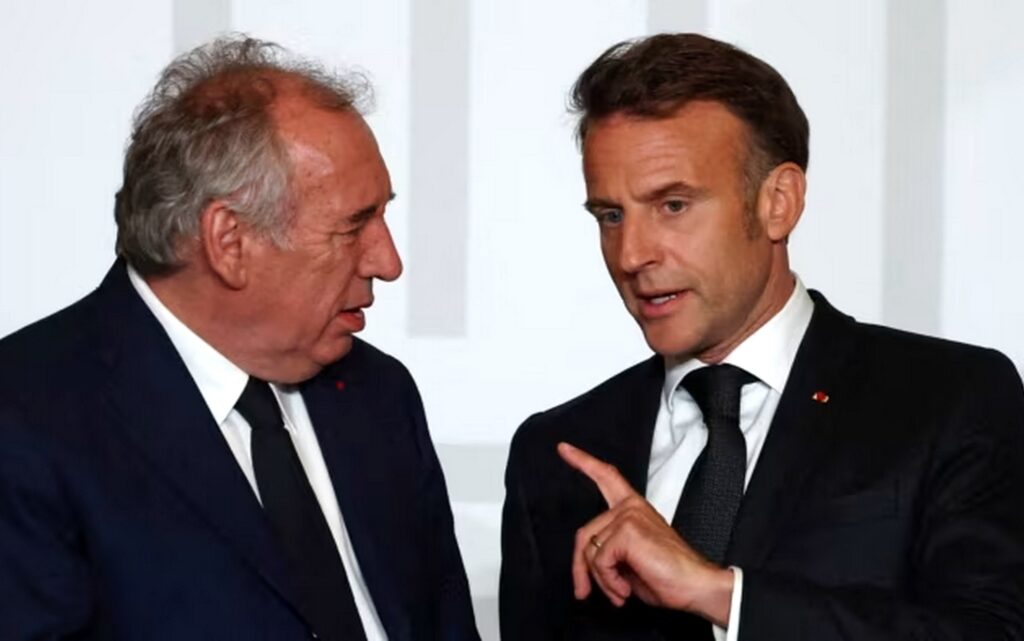
With the near-certain fall of François Bayrou’s government on Monday, French President Emmanuel Macron once again faces the thorny political equation of finding his fifth prime minister since his re-election in May 2022.
France has been experiencing unprecedented political instability under the Fifth Republic, established in 1958, since the country’s president dissolved the National Assembly in June 2024 following the far-right’s resounding victory in the European elections.
The subsequent early legislative elections produced three blocs without a clear majority (a left-wing alliance, a center-right alliance, and the far right), making any confrontation between them extremely fragile.
The French Prime Minister called for a vote of confidence in his government based on the 2026 budget proposal, which calls for a $44 billion spending cut and the cancellation of two public holidays to curb the country’s spiraling debt, which represents 114% of GDP.
The left and the far right have announced they will vote against the bill, making the government’s downfall inevitable and opening the door to a new era of political uncertainty in the European Union’s second-largest economy.
Officials from the far-right National Rally called for a very rapid dissolution of the French National Assembly.
Recent polls show the Rally would come in first in the first round of a potential election.
Macron addressed this possibility, stressing that he didn’t want to resort to it, without officially ruling it out entirely.
Mathieu Gallard of the Ipsos Institute believes that dissolving parliament will likely not change the situation, stressing that based on the results of opinion polls in recent days, the balance of power remains generally more or less unchanged compared to 2024.
The radical left-wing France Insoumise party, for its part, is calling for Emmanuel Macron’s resignation.
An opinion poll published Thursday showed that 64% of the French want early presidential elections.
However, the French president confirmed in late August that he would complete his term until 2027.
His preferred option remains finding a new prime minister.
The Socialist Party, with 66 deputies, was the most willing to offer an alternative, proposing a budget with a 22 billion Euro cut, based primarily on a 2% tax on wealth exceeding 100 million Euros, as well as suspending the pension reform due in 2023.
However, obtaining majority support on the basis of this program will not be easy.
This option could prompt the withdrawal of the right-wing Republicans party (49 deputies) from the current government coalition, most likely the Horizon party led by former Prime Minister Édouard Philippe (center-right, 34 deputies), and even the Democratic Movement (Modem) led by François Bayrou (center, 36 deputies).
On the left, the France Insoumise party (71 MPs), an ally of the Socialists in last year’s elections, denounces a “disgusting concoction” that will bring the Socialist Party into power with Macron’s entourage.
The solution may lie in a prime minister who is not a member of the Socialist Party and who is acceptable to a broad segment of the population, from the center-right to the Socialist Party.
Bruno Cotris, a political expert at Yébéouf, believes that no bloc currently has the electoral legitimacy to undertake the sweeping reforms Bayrou sought.
“Perhaps the solution is to say: We need to calm things down so that we can discuss public finances more broadly in 2027, and try to find a figure who can reflect a sense of calm toward the financial markets and the country,” he explained, mentioning the names of National Assembly Speaker Yaël Brun-Pivet and Economy Minister Eric Lombard.
This new political crisis comes amid a climate of skepticism toward politicians who haven’t proven effective in responding to the country’s problems, according to what 90% of French people said in an opinion poll published Wednesday.
In addition, a call has been circulating on social media since the summer calling for a “complete shutdown of movement” on September 10.
This multifaceted mobilization, whose scope is unpredictable, includes non-partisan but typically left-leaning groups such as the Yellow Vests, activists from political parties such as France Insoumise, and unions such as the General Confederation of Labour, which called for a strike that day.
On September 18, all trade union organizations called for a strike and demonstrations.
If successful, these demonstrations could put pressure on government deliberations, as Matthieu Gallarde sees it, explaining, “It will weaken the president and push leftist forces and the National Rally into a kind of bidding war”.