A NATO official predicts the end of the economic system and warns of a world war
As the war between Israel and Iran enters its eleventh day, and the United States joins Israel against Iran, concerns are growing about the repercussions for the security of vital maritime routes.
The Straits of Hormuz and Bab al Mandab, two vital arteries for global trade, are at the forefront of the situation, threatening catastrophic repercussions for the entire global economy, the first signs of which are already emerging.
Major economic institutions estimate that more than 30 percent of energy trade passes through areas directly or indirectly affected by the current conflict, most notably the Strait of Hormuz, Bab al Mandab, and the Suez Canal.
Warnings are mounting that the ongoing conflict between Tel Aviv and Tehran is putting the entire global trading system on the brink of collapse.
Indeed, global markets experienced sharp fluctuations, with oil prices jumping 28% in just one week and container traffic through the Suez Canal declining by 40%.
Meanwhile, marine insurance costs have more than tripled, with reports of container shortages and frequent delays in shipments from Asia.
This conflict may be a turning point in reshaping the current global economic order, as international and regional efforts accelerate to contain or mitigate the damage.
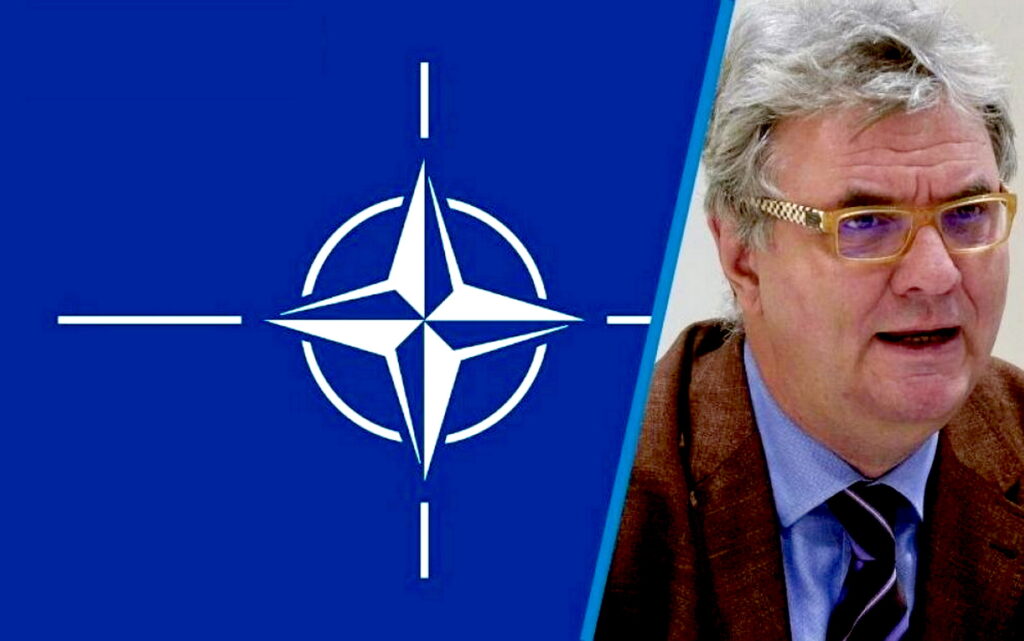
According to Alessandro Politi, director of the NATO Defense College Foundation, he warned that the threat is no longer theoretical.
“We’ve actually entered a phase of active confrontation that affects the security of maritime routes,” he said.
Regarding the nature of the current threat to maritime shipping lanes, Politi said, “Currently, the threat is indirect, as much depends on the balance of power between Iran and Israel, as well as recent US decisions”.
He believed that “the most likely danger is the use of unattributed sea mines (not claimed by any party) to create widespread tension in the markets, or the return of the Revolutionary Guard’s light boats to attack and sink enemy ships”.
Regarding the alliance’s role in securing these waterways, Politi said, “NATO will only intervene based on a UN mandate, as is the case with anti-piracy missions”.
He added that “regional powers (allied with the United States) can be supported by the operations of the US Fifth Fleet (in Bahrain), within its traditional area of operations”.
Regarding the possibility of Tehran closing the Strait of Hormuz, Politi said, “Iran exports a lot to China (it imports most of Iran’s oil), so it’s not in its direct interest to take such a step”.
The Strait of Hormuz lies between Iran to the north and the UAE and Oman to the south.
It connects the Arabian Gulf to the north and the Gulf of Oman and the Arabian Sea to the south.
Approximately 40% of the world’s seaborne oil, 20% of liquefied natural gas, and 22% of basic commodities pass through it.
Politi asked, “Did you know that there are dozens of Chinese cargo planes rotating through Iranian airports and that many Chinese ships are unloading unspecified cargo?”
He believed that the conflict has already begun to raise questions about the normalization agreements (between Arab countries and Israel), and could create serious political problems for the Israeli government.
Assessing whether the world is witnessing a far-reaching strategic shift in the international order, Politi said, “Yes, indeed… The Bretton Woods system and its offshoots are approaching the end of their usefulness for the international community as a whole, whatever that means”.
Before the end of World War II (1939-1945), the Allies, led by the United States and 43 countries, met in 1944 in Bretton Woods, New Hampshire, in the northeastern United States, and formulated the new financial and economic order in the world.
Politi added, warning that the danger lies in a potential hegemonic confrontation between China and the United States in the Pacific, a confrontation that could actually ignite a world war.
He believed that the existing possibility is that the US administration, driven by its instincts, will find a face-saving partnership with China’s pragmatic leadership, but one that raises major questions about the future of globalization.
Regarding the worst-case scenario for the alliance, given the war’s impact on global trade flows, Politi said, “NATO takes the issue of securing energy supplies and other strategic materials seriously, but it doesn’t have a comprehensive energy policy”.
He added, “NATO member states are naturally divided into: oil shale energy suppliers, nuclear power plant owners, and diversified energy buyers”.
He added, “Cheaper Russian energy supplies are an important factor that importing countries will take into account for the future”.
He pointed out that the European Union has an energy policy whose primary goal is to end its dependence on Russian energy, despite some question marks, and the primary outcome of this policy has been higher energy prices.