German elections: A slight victory for the right wing as the far right AfD made a historic advance
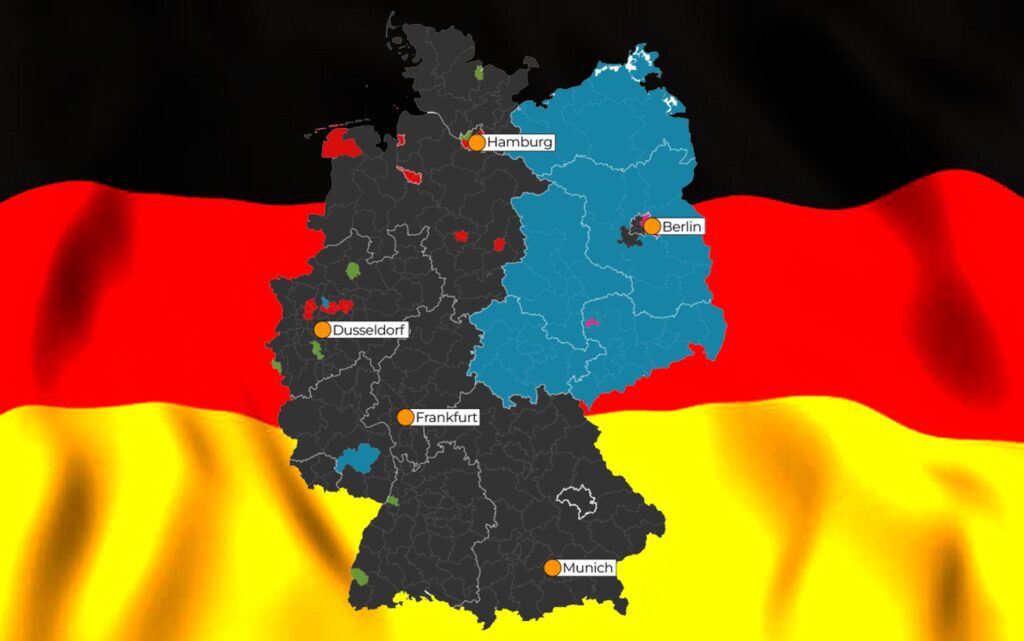
German conservative leader Friedrich Merz said on Sunday that he wants to form a government as soon as possible to overcome Germany’s crises, while the far-right made historic gains.
“The outside world won’t wait for us and won’t wait for long coalition negotiations,” Merz, (69), said in Berlin after the victory, which puts him on course to become chancellor if he finds allies to govern.
“We must be ready to act quickly again to do what is necessary internally, to be present in Europe again,” he said.
The shift to the right comes at a pivotal moment for Germany and its European allies, who have been shaken by Donald Trump’s announcements about the war in Ukraine, fears of a collapse in the transatlantic alliance, and threats of higher tariffs.
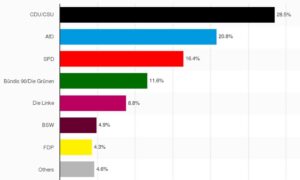
After being predicted to win for months, the conservative Christian Democratic Union and their Bavarian ally, the Christian Social Union, took 29% of the vote, according to initial estimates.
The Alternative for Germany party (AfD) came in second with about 20% of the vote, double the percentage it won four years ago, and a historic result for the far-right party founded in 2013.
“Our hand will always be extended to participate in the government and implement the will of the people,” said party leader Alice Weidel.
But the conservatives rule out any alliance with the AfD, despite their parliamentary flirting over immigration and security issues during the election campaign.
For his part, outgoing Chancellor Olaf Scholz announced that he bears responsibility for the “bitter defeat” after his Social Democratic Party obtained about 16% of the votes.
This decline is unprecedented for the oldest party in Germany since the end of World War II.
The other loser in this election was the Green Party, which participated in Scholz’s government and won 13% of the votes.
Merz said on Sunday that Europe should strengthen its defense capabilities, amid rising tensions between the United States and Europe.
“The absolute priority will be to strengthen Europe as quickly as possible so that we can, step by step, achieve independence from the United States on defense issues,” Merz said.
“After Donald Trump’s statements last week, it’s clear that the Americans… are largely indifferent to the fate of Europe,” he added.
Ukrainian President Volodymyr Zelensky congratulated Merz on Sunday, hoping to work with Germany to strengthen Europe.
French President Emmanuel Macron also congratulated Merz on Sunday, saying, “We’re more determined than ever to do great things together”.
British Prime Minister Keir Starmer congratulated the German conservatives on Sunday, saying he wanted to work to strengthen security between the two countries.
“I look forward to working with the new government to deepen our already strong relationship, enhance our shared security and ensure economic growth for both our countries,” he wrote on X.
The early parliamentary elections were held on the eve of the third anniversary of the Russian invasion of Ukraine, which left a shock in Germany.
The conflict has cut off supplies of cheap Russian gas, causing the economy to stagnate, and Germany has taken in more than a million Ukrainian refugees.
The possibility of reaching peace behind the backs of Kyiv and the Europeans is of great concern.
In this context, European partners are keen to speed up the formation of a government in Germany.
Merz has hinted that he would prefer to reach out to the Social Democratic Party.
This potential alliance, called a grand coalition between the two parties that dominated the political scene in the post-World War II period, is the preferred option for Germans after a period of continuous turmoil within the three-party government coalition between the Socialists, the Greens and the liberal Free Democratic Party.
In this regard, Meretz said that he wanted to avoid forming a three-party coalition.
The federal democratic party, failed to pass the 5% threshold to enter the Bundestag, as does Sarah Wagenknecht’s coalition, a new left-wing conservative party that calls for an end to arms deliveries to Ukraine.
The leader of the German Liberal Party, Christian Lindner, the former finance minister who was dismissed by Chancellor Scholz last November, announced on Sunday his retirement from political life after his party’s defeat in the legislative elections.