Lavrov: Moscow, Tehran, Ankara agree to facilitate cessation of hostilities in Syria
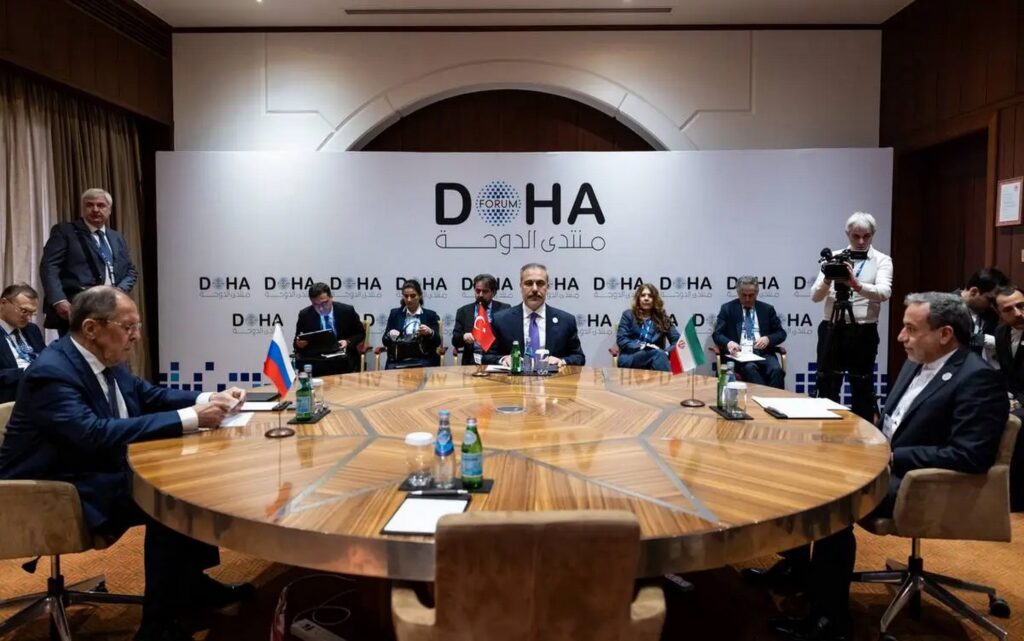
Russian Foreign Minister Sergei Lavrov confirmed that Moscow, Tehran and Ankara have reached an agreement aimed at facilitating a cessation of hostilities in Syria, indicating Russia’s support for the resumption of negotiations between the Syrian government and the opposition.
In response to a question about the possibility of starting negotiations between the opposition and the Syrian government, Lavrov said, “We have extended an invitation to negotiations and we will work with all parties, including the government and the opposition”.
He added that there is a group of opposition that works with Moscow on a regular basis, in addition to communicating with other opposition figures in different capitals such as Riyadh and Istanbul.
Lavrov explained that after Iran, Türkiye and Russia agreed to support the cessation of hostilities, the parties concerned will take steps on the ground and with the opposition to resume negotiations.
Lavrov pointed out the importance of separating the terrorist Hay’at Tahrir al Sham militants from the moderate opposition, stressing that the group is launching organized attacks against the Syrian government, and that Moscow supports Damascus in confronting these attacks.
He added that political dialogue will be possible after the Hay’at Tahrir al Sham attacks stop, stressing that Russia will continue to support the Syrian government in confronting the terrorist group’s attempts to change the military balance on the ground.
In this regard, sources revealed that, on Saturday, during the meeting a circulated roadmap to resolve the Syrian crisis was discussed between Türkiye, Russia and Iran, with the aim of discussing developments in the situation in Syria.
The roadmap includes several points, most notably the start of implementing UN Resolution 2254, which calls for a ceasefire and reaching a political settlement in Syria.
Under the map, all forces would withdraw to their bases, joint police units would protect cities, and all foreign forces would withdraw from the country by the end of 2025, while, Russia, Iran and Türkiye monitor the ceasefire.
The resolution also stipulates the formation of a national unity government under the supervision of a team from the United Nations and the Arab League, within a month.
According to the circulated map, President Bashar al Assad will remain in office for a period ranging from 6 to 9 months, with a large part of his powers transferred to an independent prime minister who will be agreed upon.
It also stipulates the formation of a new committee to write the country’s constitution, consisting of three thirds: one third appointed by the United Nations, one third from Damascus, and one third from the Syrian coalition.
The new government calls for presidential and parliamentary elections with new names in 6 to 9 months.