Syria: Half of Aleppo city is under the control of Hay’at Tahrir al Sham and Syrian opposition factions
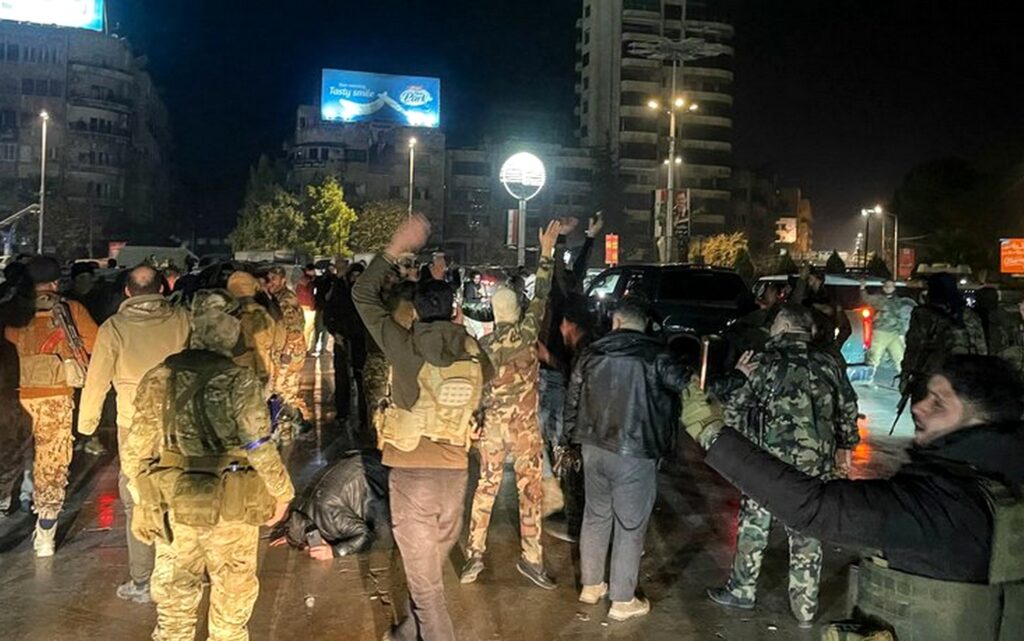
Half of the city of Aleppo in northern Syria is now under the control of Hayat Tahrir al Sham and allied factions, the Syrian Observatory for Human Rights reported early Saturday, two days after those factions launched a surprise attack on areas controlled by the Syrian government in northern and northwestern Syria.
“Half of Aleppo is now under the control of Hay’at Tahrir al-Sham and its allied factions,” Observatory director Rami Abdel Rahman said.
He added, “fighters had reached the Aleppo Citadel, as there was no fighting, not a single shot was shot, amid a withdrawal of Syrian army forces”.
Armed groups, including Hay’at Tahrir al Sham and factions supported by Türkiye, entered the city of Aleppo in northern Syria on Friday, after shelling it in the context of a sudden and rapid attack that they launched two days ago on government forces, the most violent in years, which also enabled them to control the city of Saraqib in Idlib province, according to the Observatory.
Hay’at Tahrir al Sham and opposition factions took control of the city of Saraqib in Idlib province.
The importance of Saraqib is that it prevents any scope for the Syrian army to advance towards Aleppo, and it’s located at a strategic junction linking Aleppo to Latakia and Damascus.
This is the first-time armed factions have entered Aleppo since the Syrian army regained full control of the city in 2018.
A France Presse correspondent in Aleppo reported clashes between factions, Syrian forces and groups supporting them.
Also, two eyewitnesses from the city saw armed men in their area, amid a state of panic.
The military operations claimed the lives of 277 people, according to the observatory, most of whom were fighters from both sides of the conflict, including 28 civilians, most of whom were killed in bombing by Russian aircraft supporting Syrian forces.
The attack began at a critical juncture in the Middle East, with a fragile ceasefire in effect in Lebanon between Israel and Hezbollah, which has been fighting alongside Syrian army forces for years.
By Friday, the factions had taken control of more than 50 towns and villages in the north, in the biggest advance in years by anti-government groups.
Hay’at Tahrir al Sham fighters and their allies cut off the road linking Aleppo and Damascus.
A university dormitory in Aleppo was bombed on Friday, killing four civilians, according to the official SANA news agency.
The fighting has displaced more than 14,000 people, nearly half of them children, according to the UN Office for the Coordination of Humanitarian Affairs.
On parallel, Syrian Army reinforcements arrived in Aleppo, aiming to stop the Syria opposition rapid advance.
Türkiye called on Friday for a “cessation of attacks” on the city of Idlib and its surroundings, the stronghold of the armed opposition in the northwest of the country.
The Turkish Foreign Ministry spokesman wrote on X, that the recent clashes led to an unwanted escalation of tensions in the border area.
The fighting resulting from this attack is the most violent in years in Syria, which has witnessed a bloody conflict since 2011 following popular protests against the government that has claimed the lives of more than half a million people, displaced millions, and destroyed the country’s infrastructure and economy.
In 2015, Russia intervened alongside the Syrian army, and was able to turn the tide in favor of its ally, after it lost most of the country’s territory.
During the two months of war against Hezbollah in Lebanon, Israel intensified its strikes on pro-Iranian factions in Syria.
These factions, most notably Hezbollah, have provided direct support to Syrian forces over the past years, enabling them to regain control over most of the country.
On Friday, Kremlin spokesman Dmitry Peskov considered what is happening in Aleppo to be a violation of Syria’s sovereignty.
He expressed his country’s support for the Syrian government in restoring order in the region and restoring constitutional order.
For his part, Iranian Foreign Minister Abbas Araghchi stressed in a statement Iran’s continued support for the Syrian government, security and army in its struggle against terrorism, after a phone call with his Syrian counterpart, Bassam Sabbagh.
In Idlib, the head of the “Salvation Government” that runs the areas controlled by Hay’at Tahrir al Sham, Muhammad al Bashir, said on Thursday that the reason for the military operation was the regime’s mobilization in the previous period on the contact lines and its bombing of safe areas, which led to the displacement of tens of thousands of civilians.