The new Russian “Oreshnik” hypersonic missile!
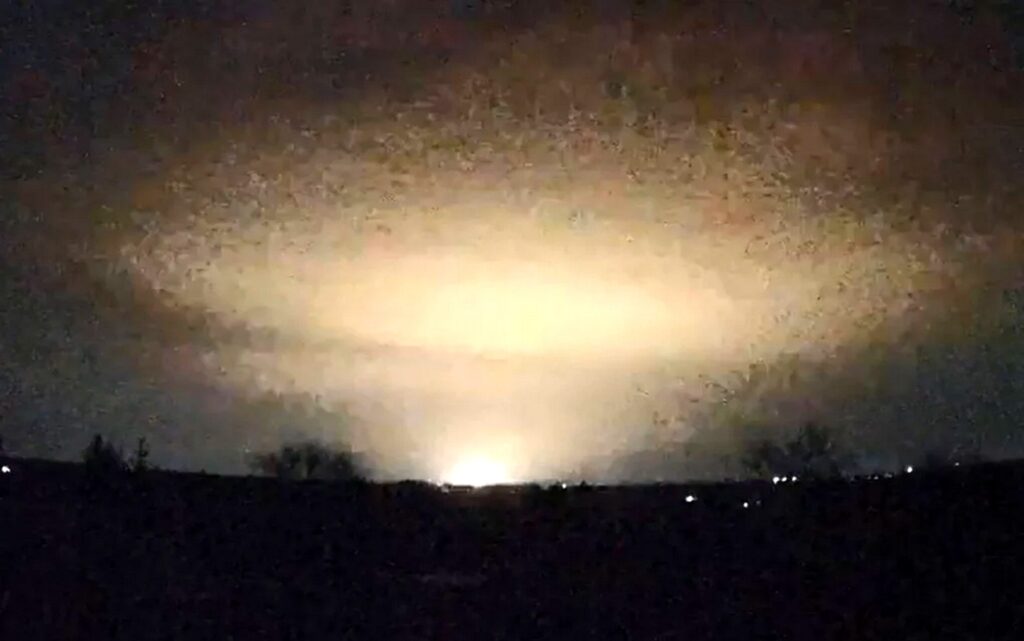
The Russian President Vladimir Putin on Thursday hailed the launch of a new hypersonic missile at a Ukrainian arms factory, the first time Russia has used the hitherto unknown weapon against Ukraine and as a warning to the West.
On Friday evening, Putin ordered the mass production of this missile and new tests of it in combat conditions.
Until its use on Thursday, the existence of this new missile was unknown.
Putin described it as a medium-range ballistic missile that could therefore reach targets between 3,000 and 5,500 kilometers away.
According to the Russian president, the missile launch was a test in combat conditions, which means that the weapon is still under development.
He didn’t give any indication of the number of systems in existence, but threatened to use them again.
“Oreshnik is the name of the project, it’s just a code name, and the system itself is called “Kidr,” said Kirillo Budanov, head of Russian military intelligence.
Budanov expected, based on Ukrainian information dating back to October, that “Russia will produce two models”.
A senior source in the Ukrainian General Staff said that Russia has only a few units.
The distance between the Russian region of Astrakhan, from which the Oreshnik missile was launched on Thursday, according to Kiev, and the Pevdynmash satellite manufacturing plant, which was hit by the missile in Dnipro (central eastern Ukraine), is approximately 1,000 km.
Although it doesn’t fall into the category of intercontinental missiles (with a range of more than 5,500 kilometers), if launched from the Russian Far East, the Oreshnik could theoretically hit targets on the West Coast of the United States.
“Oreshnik missile could also threaten almost the whole of Europe,” Pavel Podvig, a researcher at the United Nations Institute for Disarmament Research (Unidir) in Geneva.
Until 2019, Russia and the United States couldn’t deploy such missiles under the Intermediate-Range Nuclear Forces Treaty signed in 1987 during the Cold War.
But in 2019, Donald Trump withdrew Washington from this text, accusing Moscow of violating it, opening the way for a new arms race.
During a meeting with military officials on Friday, Putin confirmed that Moscow has a reserve of these missiles ready for use.
During the meeting, the commander of the Russian Strategic Missile Forces, Sergei Karakayev, stressed that the massive use of this missile would be similar to the use of a nuclear weapon.
He explained that it was developed based on an order issued by Putin in July 2023.
Pentagon deputy press secretary Sabrina Singh explained to reporters Thursday that the Oreshnik is based on the Russian model of the RS-26 Rubezh intercontinental ballistic missile (itself a derivative of the RS-24 Yars).
“This system is very expensive and isn’t produced in large quantities,” according to military expert Ian Matveyev, who said on Telegram, adding that the missile could carry an explosive charge weighing several tons.
In 2018, the RS-26 Rubezh armament program, the first successful test of which dates back to 2012, was frozen, according to the state-run TASS news agency, due to the lack of means to implement this project simultaneously with the development of the new generation “Avangard” hypersonic systems, which are supposed to be able to reach a target almost anywhere in the world.
According to Putin, the Oreshnik missile launched Thursday “in its non-nuclear hypersonic configuration” can reach speeds of Mach 10, or 2.5 to 3 kilometers per second (about 12,350 kilometers per hour).
The Ukrainians reported that the speed reached by the missile in the final part of the trajectory on Thursday exceeded Mach 11 (about 13,600 km/h).
Finally, the Oreshnik missile will also be equipped with maneuverable charges in the air, making it more difficult to intercept.
Putin stressed that the air defense systems currently available in the world and the missile defense systems installed by the Americans in Europe do not intercept these missiles… This is unlikely.
A video of the Russian launch, posted on social media, showed six successive powerful flashes falling from the sky at the time of the attack, indicating, according to experts, that the missile was carrying at least six payloads.
This involves equipping a missile with multiple warheads, nuclear or conventional, each of which follows an independent path as it enters the atmosphere.