Victory Day over Nazism: Symbolism of History and its Impact on the International Political Arena
By: Contribution for Syrializm
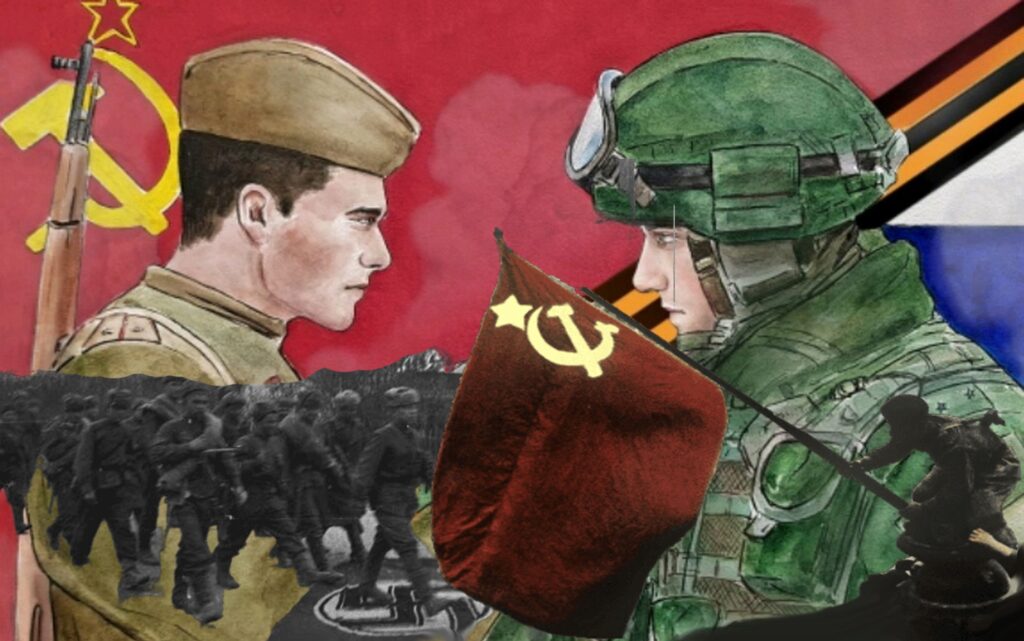
Russia’s celebrations of Victory Day over Nazism are considered a significant historical occasion that embodies the great memory of the victory over Nazi and fascist forces during World War II, as these celebrations take place on the 9th of May each year and witness majestic festivities commemorating the heroism of the peoples of the Soviet Union and the sacrifices of the Red Army in defeating Hitler’s Nazism.
The origin of these celebrations’ dates back to the great victory achieved by Soviet forces and the Allies over Nazi Germany in World War II, and reflect the national and patriotic spirit in Russia, highlighting pride in the country’s history and its people’s courage and steadfastness in the face of a deviant ideology that was coupled with an aggressive, ruthless war machine that saw in many countries and peoples that they were below the status of human standards, as in their “Superior” world there is no place for such.
For several years, Victory Day celebrations have been taking place amid a tense international situation, with the world witnessing political and economic transformations amidst escalating tensions between Russia and Western countries, with several points of conflict in regions like Ukraine and the Middle East, the celebrations raise questions about the future of international alliances and the ability of the international community to confront new challenges.
Thus, the Russian leadership exploits these celebrations to enhance the country’s international image and affirm its role on the global stage.
This affirmation is accompanied by criticisms of the foreign policies of Western powers, especially those trying to undermine Russia’s role internationally.
The Russian government uses this event to reaffirm internal solidarity and bolster political stability, as media campaigns and aggressive attacks on the Russian homeland escalate, hoping to destabilize internal stability and incite public opinion in Russia against its government.
This comes as signs of the military failure of the conflict in Ukraine emerge, despite the West’s insistence on continuing to support Kiev with money and weapons.
Western countries, including the United States and Europe, are exhausting all their resources in providing everything to Kiev, hoping to counter Russian forces, which continue to achieve significant accomplishments on the ground, while the warehouses of NATO countries are almost empty of equipment, with bleeding budgets and desperate searches for any old scraps and obsolete weapons from anywhere, regardless of the cost.
Away from today’s international arena, and returning to the essence of Russian interest in preserving the significance and form of these celebrations, which have taken on the form of an annual tradition since 1945, the importance of Victory Day celebrations in Russian memory is manifested within the historical context shaped by World War II and the unique experience of the Russian people in confronting aggression.
The prominent role of Soviet forces in achieving victory, starting from repelling German invaders from Soviet territories through historic battles documented in history books, and documentaries, to the liberation of Eastern Europe and the entry into Berlin, toppling the flags of the Third Reich in its stronghold, meters away from the bunker of the Führer, who ordered his followers to burn his body, knowing that the Soviets were coming, and that his end in their hands would be much more terrible than the crimes of his barbaric regime.
Through celebrating this anniversary, Russians reaffirm their commitment to national values and pride in their historical heritage.
Russia’s dedication to commemorating Victory Day on the 9th of May each year, with all its symbolism and significance, has become part of Russian traditions and culture in general, despite the circumstances and times, the celebrations, especially the military parade, always appear in the best and most splendid manner possible, with the presence of the Russian leadership at its highest levels, led by the President of Russia.
The attendance of war veterans and their families in the military parade is also a token of appreciation for their sacrifices in liberating the land from Nazism and advancing towards the decisive victory.
This occasion has remained an opportunity to invite world leaders as honorary guests to these celebrations, especially victorious Allied nations in the war, aiming to convey two important messages:
Firstly, that we were partners in this victory, which wouldn’t have been achieved without this alliance.
Secondly, that Russia is the heir to the great Soviet Union and remains a great global power, and that the experience of the Soviet Union’s collapse was a phase in history.
Russia’s focus on commemorating this occasion aims, as it does, since the collapse of the Soviet Union, to remind new generations of pivotal historical points, as their ancestors and parents played glorious roles in defending the homeland and defeating Nazi ideology and fascist tendencies.
These threats persisted, historically positioning themselves as Russia’s enemies, instilling in the new generation a deep conviction regarding impending threats to their homeland, and shaping their psychological and mental makeup, beliefs, and national pride based on historical and geographical facts, which are impossible to falsify as they are well-documented; They do not require propaganda or brainwashing techniques.
The value of the land they live on, with all its heritage and entrenched past, makes the new generations staunch believers in the justice of their beliefs.
They defend their heritage, land, and history, and the resources of their country, created by God on this land to be a means of reconstruction and prosperity for their present and future, and a weapon against any aggression.
It is a blessing for progress as a tool of economic and life necessities, as it is part of the global economy, irreplaceable despite attempts to find alternatives that have proven unsuccessful and unreliable.
On the other hand, we find that Allied countries like the United States, Britain, and even France, do not give this occasion the same importance; They consider it a passing matter that does not extend beyond protocol-based celebrations.
We don’t endorse conspiracy theories, but since the end of World War II, we have witnessed the subservient and loyal behavior of Western Europe to the United States regarding all matters related to international peace, combating extremism, and Nazi ideologies, as all these elements serve to solidify Western dominance over world countries, with no genuine effort to combat these destructive ideologies and practices.
On the contrary, they ensure support for them if it serve their interests, or at least turn a blind eye, as long as such narratives serve their purposes.
What they call it terrorism and extremism become so only when it threatens their interests.
Nazi and fascist ideologies are only dangerous if they cross their red lines, otherwise, they consider them “freedom of opinion and belief, a legitimate right of one group over another,” even if this group is an aggressive, oppressive force, using Western-made killing machines to slaughter innocents.
Despite differences in approach, at least in principle, the West, particularly its master (the United States), has contracted one of the most repugnant diseases: neglect of veterans, and neglect of establishments, memorials, and monuments that recall the war and victory over Nazism.
Especially those structures that several European countries have persisted in removing and demolishing for years, representing the sacrifices and roles of the Soviet army and even their peoples in liberating their land from Nazism.
Meanwhile, some of their citizens collaborated with the Nazis and fought alongside them without shame.
Today, we see their new generations carrying the same flags that the Red Army threw it on the ground at the heart of Berlin’s Reichstag in 1945.
That deep-seated animosity, which serves as evidence to the observer of current affairs, reveals the truth of the matter, for anyone who wishes to examine it and judge it objectively and impartially.
Those who look today at these actions of erasing heritage and historical memory, by removing the monuments and symbols that have stood for decades as memorials of victory and liberation, find them coupled with the resurgence of Nazi ideology and fascist tendencies in those countries.
These ideologies have remained hidden behind a thin veil of democracy, which is torn apart and fades away under scrutiny, with the chaos of moral decline and the deterioration of the quality of life and prosperity of their people, many today in those European countries cast their votes for far-right parties, hoping to save their nations from a clique of reckless politicians devoid of awareness of the true interests and aspirations of their countries and its public.
In the United States, for decades it has been seen as the “great” nation, boasting its formidable military machinery and technologies, yet it neglects the care of its soldiers and veterans, especially those who have been injured during their service in wars that were, in fact, aggression against other nations.
Since the Korean War, through Vietnam, and the occupations of Afghanistan and Iraq, we continually hear these harrowing stories of neglecting veterans, making them prey to depression, madness, and diseases, which often lead them to commit crimes or engage in mass shootings.
The US soldier, who lived under the illusion of pride in his country’s military uniform, finds himself deceived by the illusion of serving his country, the United States, to fight in distant lands, only to end up either disabled or with chronic mental illness, often leading to crime or suicide, not to mention the destruction and disintegration of his family.
What is even more ironic is that the concern for him and his fellow veterans becomes part of the political game and elections showdown between Democrats and Republicans.
Turning back to Europe, where occasionally, some timid voices speak about European autonomy, attempts by some European leaders to occasionally talk about the need to create a European army to defend the continent without relying on the United States.
This hints shyly at the reality of the demise of the North Atlantic Treaty Organization, reaching beyond the walls of the hall where they speak.
However, despite these statements, threats like those made by former US President Donald Trump to Europeans that the United States is no longer interested in defending Europe for free, and that Europeans must pay for American protection.
In fact, it must be remembered that all these threats do not exceed the boundaries of the blackmail and bargaining games practiced by the United States with its allies, as sometimes using the stick and sometimes using the carrot.
The truth is that the United States rebuilt Europe after World War II to be its eternal satellite, following and implementing policies without debate.
If rebellious voices emerge, the result is popular unrest, like the one that ousted Charles de Gaulle in 1969, or the yellow vests against the current boy in the Élysée Palace.
It has become well-known that the American decision deprives Europeans of rapprochement with Russia, and removes Russia from the category of traditional enemies.
Even Germany, which has benefited economically for decades from Russian energy supplies, finds itself hostage today to a group of politicians who are running the country in what can only be described as a crazy manner.
Even the infrastructure that used to transport energy from Russia to Germany has been destroyed, after the United States has expressed dissatisfaction for years with the existence of such projects.
The dissatisfaction with cooperation between Berlin and Moscow has reached the level of direct threat, as everyone remembers the former US ambassador to Berlin, Richard Grenell, who carried out his “diplomatic” duties as if he were the high American commissioner in Berlin!
All these complications today paint a bleak picture of the continent’s future that witnessed total destruction in World War II.
In light of the escalation happening today, only the madmen desire to see Europe destroyed again, but here we ask: Who benefits from the destruction of Europe?
Does it make sense that Russia would benefit from the destruction of Europe, especially when it has been providing its resources at cheap prices for years, allowing the countries of the European continent, particularly its Western states that form the basis of the European Union and NATO, to thrive economically?
In principle, Russian interest is based on achieving stability in the continent that witnessed two world wars in the last century.
However, in return, the stability of Europe will not be at the expense of Russia’s national security.
In keeping with the Russian renaissance and the victory, the Russian decided to show the captured
West’s equipment that was provided to the Kiev Nazis in the Victory Day military parade, as that will be a clear message, which will be subject to an expected field escalation that will be more severe, with the United States and its followers continuing to provide support to a corrupt clique.
Those in Kiev are still pretending to be patriotic, while the Western media continues to do desperate marketing for them, showing them as idealists, victims of aggression, while their role was merely bait, aiming to hurt the same old enemy of the West.
The commemoration of Victory Day in Russia has remained a symbol of the great memory of the victory over Nazism and fascism during World War II.
It reflects the preservation of national unity, the revival of national spirit, the strengthening of national identity, and the national belonging of the Russian people, with pride in their historical achievements and sacrifices made for victory.
This serves as the basis for maintaining the unity and freedom of the country, while reminding of Russia’s role in preserving international peace and security, which remains essential despite all hostility and attempts of isolation practiced against it.
Those who have sacrificed millions to uproot deviant Nazi ideology cannot stand idly by today, seeing those same countries that were once either perpetrators or victims, aligning themselves with the same ideology that led their countries to destruction, while remaining subservient behind the United States, as this has no bearing even on the interests of their own country and its prosperity.