Al Hurra: Why does Assad prevent solidarity with Gaza demonstrations?
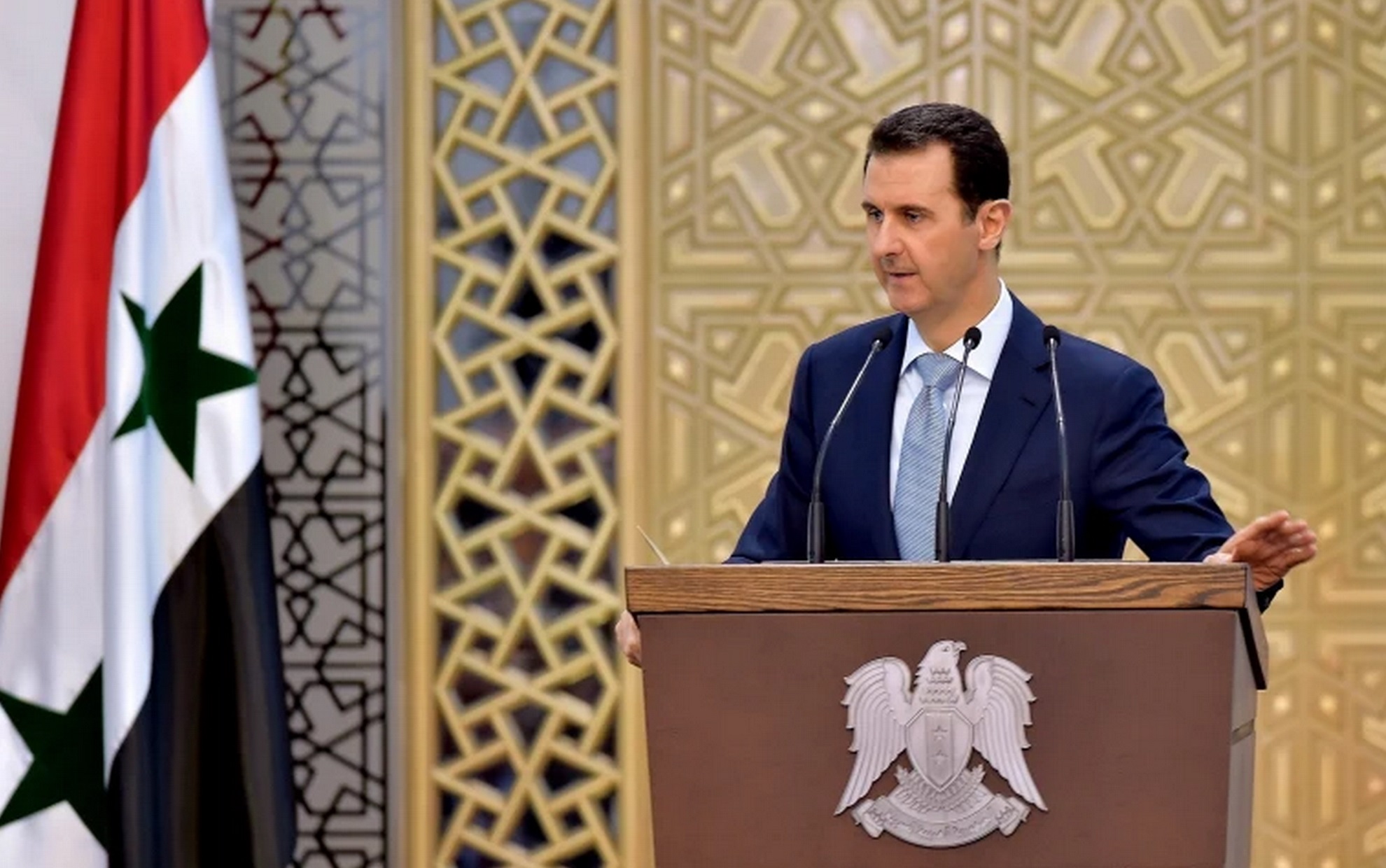
During the past few days, the Syrian regime imposed security approval on Palestinian parties and factions in order to organize solidarity events and stops with the population in the Gaza Strip, and media reports stated that the justifications for the step came under the heading protection from terrorism and armed gangs and maintaining security and safety.
According to the Action Group for the Palestinians of Syria, a human rights and media network, representatives of the Palestinian factions and residents in the Khan Danoun camp in the Damascus countryside and many camps have complained about the obstacles imposed by the Syrian security services.
The director of the group’s media office, Fayez Abu Eid, spoke to US government funded Arabic news Channel al Hurra TV, that the security authorities affiliated with the Syrian regime have restricted the organization of any demonstration or rally, except in the case of going through a strict security examination that may take weeks and result in rejection.
The Syrian security restrictions included refusing to approve a solidarity vigil with candles for the children of Khan Danoun camp, and earlier last week the Syrian regime authorities had prevented the Palestinian factions present on Syrian territory from organizing any demonstrations near the Golan.
The “Action for the Palestinians of Syria” group quoted informed sources in the Syrian ruling “Baath Party” as saying, “The instructions were based on security and political assessments indicating that any such step might anger the Israeli and the US sides, and expose Syria to the risk of military intervention by them”.
According to sources in Syria, the activities of the Palestinians in Syria in solidarity with Gaza were restricted, from one of those familiar with their affairs in the city of Homs.
Meanwhile, the new policy wasn’t limited to Damascus only, but rather extended to reach areas where Palestinians gather, such as Aleppo and Homs.
Since the beginning of the Hamas attack, on the seventh of last October, and the subsequent war initiated by Israel in the Gaza Strip, the Syrian regime has adhered to a policy that observers considered to be within the framework of staying away from the scene and trying not to get involved.
Despite the statements issued by the Syrian Ministry of Foreign Affairs, condemning what is happening in the besieged Gaza Strip against the Palestinians, the diplomatic language it used did not go beyond the scope of condemnation and denunciation.
For decades, the Syrian regime has always emphasized the idea that “Syria is part of the axis of resistance,” and while the name of Palestine and its cause was repeated in most of the speeches of its president, Bashar al Assad, his forces followed a different policy against them on the ground.
The Syrian Network for Human Rights documents the killing of 3,207 Palestinian refugees at the hands of Syrian regime forces during the period from March 2011 to October 2022, in addition to 2,721 who are still under arrest or forcibly disappeared.
In turn, the “Action for the Palestinians of Syria” group indicates that its documentation team has counted nearly two thousand Palestinian refugee detainees since March 2011, the largest percentage of whom are youth.
The arrest of a number of journalists and relief activists has also been documented, in addition to the arrest of many Palestinian symbols, competencies, and elites.
The director of the group’s media office, Fayez Abu Eid, says, “The security approvals that the Syrian regime is currently imposing on the Palestinian camps are new, and they weren’t previously”.
He added that it takes weeks to be accepted and often results in rejection, and it’s not in line with the slogans put forward by the Syrian regime that Palestine is its central issue.
“The new measures raise many question marks,” and Abu Eid explains that the restriction of solidarity activities with Gaza during the past days wasn’t limited to the camps in Damascus, but rather included all areas where Palestinians are present in the country.
Over the past years, whenever any incident occurred in Jerusalem and Gaza by the Israeli army, the Palestinian camps would immediately go out to express their anger and support for their people in Palestine without waiting for any security approval.
“In the past, we used to go out, young, old and women, at any event in Palestine and Gaza,” says Abu Eid, referring to a changed policy that occurred in the Syrian regime, which was translated into effect in the wake of the war that Gaza is witnessing for the 28th day in a row.
The Syrian president hasn’t made any media appearance since the Gaza War, only he met with a group of members of the diplomatic corps in the Syrian Ministry of Foreign Affairs, on October 26, with only one photo for him was published.
During his dialogue with diplomatic corps in the Syrian Ministry of Foreign Affairs, Assad accused European countries and the United States of adopting one standard in their policy, which is permanent bias towards their own interests at the expense of the interests of other peoples and countries.
While he considered that one of the most prominent reasons igniting conflicts in our region, which is now witnessing a war on Gaza, represents a blatant example of this bias, he didn’t go into details of what is happening in Gaza, in a path that contradicts what he had followed in the past, reiterating “Syria’s pivotal role in In Palestine”.
According to Alexander Langlois, an American researcher who focuses on Middle East affairs, believes that the public comments issued by the Syrian regime during the past days do not amount to Syria’s traditional position on Palestine and Israel.
Langlois told Al Hurra channel that Damascus seems to largely avoid direct references to Hamas, and that this approach is interesting given the movement’s political support for the Syrian revolution for most of the war.
Although Hamas and the Syrian regime normalized relations this year, Assad still holds negative views of the group due to its past actions inside his country.
However, Langlois points to other reasons related to the fact that Damascus represents an incredibly weak player in the region today, which provides compelling reasons for not taking a stronger position on the conflict this month.
Attention is still turning to the Syrian and Lebanese arenas and whether the escalation in Gaza will spread to them or not, especially in light of continued warnings that the war will expand to a regional scope.
The border between Lebanon and Israel witnessed remote confrontations with guided missiles and artillery shells, which resulted in the killing of Hezbollah members, but from Syria’s side, the matter was nothing more than shells and missiles of unknown origin, which prompted the Israeli army to respond at the same time.
The Israeli response recently developed to the point of striking military barracks in Dara’a and the Aleppo and Damascus airports four times, which resulted in them being out of service, without the Syrian regime announcing the return of flights through them until now.
The Syrian regime doesn’t have any tools, and therefore it’s trying to take steps backward, while committing not to make any sharp or direct statements.
Assad currently has no ability to do anything outside the lines drawn for him via Iran, and Russia in little aspect.
As for Iran which is considered one of the most prominent supporters of the Syrian regime, and also supports Hamas movement in Gaza and Hezbollah in Lebanon.
It now faces a dilemma, as it contemplates how it and its affiliated militias – known as the “Axis of Resistance” – will respond to the Israeli war on Gaza, and whether it should strengthen its revolutionary credentials at the expense of the risk of igniting a broader war, according to a report by The New York Times, Wednesday.
Thus, the current pressure on Palestinian figures in Syria based on confirmed information, especially with regard to their movements.
On the other hand, there’s no realistic regarding the Syrian regime is trying to distance itself, because it’s weak and unable to take a serious and solidarity position.
The Syrian regime lacks full sovereignty over its borders, let alone the ability to operate effectively outside its borders.
According to Alexander Langlois, an American researcher who focuses on Middle East affairs, “its main supporters (Iran and Russia) know this, and the former is likely not interested in Damascus’ deeper direct participation in a conflict with Israel at the present time”.
As such, Iranian-backed militias have largely played a background role in repeated strikes on Israel from Syrian territory.
Langlois added, “This is likely to shape the extent of the role Syria plays in the conflict, unless there is a significant escalation and expansion of the war, or if Iran finds Syria to be a more viable battlefield for a group like Hezbollah to clash with Israel at a later date”.