Tension on the horizon between Egypt and the United States over a Su 35 deal for
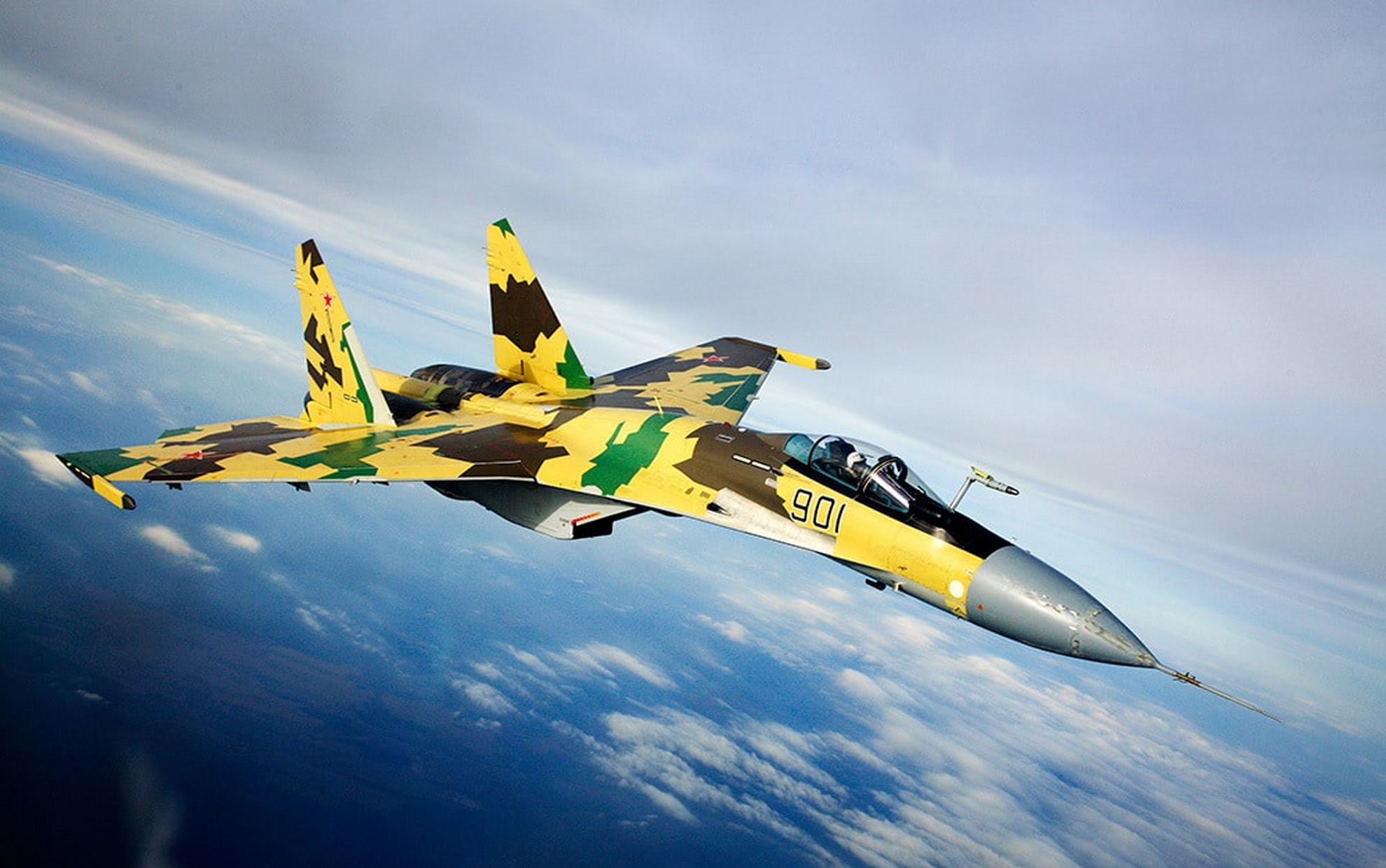
In a new development related to the Egyptian-US relations file, the US State Department said that Secretary Antony Blinken expressed Washington’s concern about the possibility of Egypt buying Sukhoi 35 fighters from Russia, in a recent phone call with his Egyptian counterpart Sameh Shoukry.
So, what is the story of that deal?
In 2019, Egypt signed an agreement with Russia worth two billion dollars aimed at purchasing about 20 Su 35 combat aircraft.
This angered the United States, as US officials hinted at the possibility of imposing sanctions on Egypt if they insisted on completing the purchase of Russian aircraft.
Facts about Egypt:
However, Egypt proceeded with that deal and has already received the first batch of five aircraft in August 2020.
The deal was first revealed by the former Russian military correspondent Ivan Safronov, who was arrested last year and charged with treason.
Safronov, who worked as an assistant to the director of the Russian Space Agency (Roscosmos), covered the military affairs of two government newspapers.
The Russian TASS news agency quoted a judicial source in June 2019 as saying that the public prosecutor wanted to institute a civil lawsuit against Kommersant newspaper for revealing a state secret.
The Bell portal indicated at the time that an article Safronov worked on had subsequently disappeared from that newspaper’s website.
In that article, it was stated that Egypt had signed a deal with Russia to purchase more than 20 Sukhoi-35 multi-role combat aircraft.
Why the Su 35 fighter?
The Sukhoi 35 is a multi-role combat aircraft.
It is capable of carrying out the tasks of air intrusion into the enemy’s sky, providing full cover for the ground forces, imposing air control in the battle sky, and neutralizing all enemy aviation movements.
This combat aircraft also has superior maneuverability, and is equipped with fifth-generation technologies to ensure air superiority over the same class of fighters, and is able to hit ground targets.
This twin-engine combat aircraft has a speed of 2,400 kilometers per hour, and is equipped with modern smart weapons that allow it to monitor and destroy a number of air and ground targets simultaneously and with great accuracy.
The CAATSA act?
US officials have hinted at the possibility of imposing sanctions on Egypt if they insist on completing the purchase of Russian aircraft.
In November 2019, Clark Cooper, the US Assistant Secretary of State for Political and Military Affairs at the time, said that the United States might impose sanctions on Egypt and deprive it of future military sales “if it bought Russian warplanes”.
The American Wall Street Journal also published a report at that time saying that the US administration threatened to impose sanctions on Egypt, noting that the White House called on Cairo to cancel that deal.
The Wall Street Journal said that then Secretary of State Pompeo and Secretary of Defense Mark Esper sent a joint letter to Cairo calling for a reversal of the deal.
In its report published in 2019, the newspaper said that the American threat came in a joint letter sent by US Secretary of State Mike Pompeo and Defense Secretary Mark Esper, calling on the Egyptian Ministry of Defense to cancel the purchase of the Russian Sukhoi-35 fighters, explaining that if Cairo does not comply with that You may face penalties.
The United States can impose sanctions under a law known as “Combating America’s Adversaries Through Sanctions”, known for short as the “CAATSA Act”, which was passed by the US Senate on August 2 of 2017 and signed by former President Donald Trump, a law that mainly targets Russian Military Sales.
The CAATSA Act was originally promulgated to punish Moscow for its annexation of Crimea.
Some observers say that Washington may threaten Cairo to reduce the value of military aid to Egypt if it insists on concluding the Russian aircraft deal.
The Egyptian army’s arsenal includes a large number of American weapons that have accumulated over decades since the signing of the peace agreement between Egypt and Israel under US auspices in 1979.
During recent decades, the United States has provided Egypt with billions of dollars in military and economic aid, including the supply of F-16 fighters, attack helicopters, and other military equipment.
The United States says the use of the Sukhoi fighters and other Russian military systems poses a threat to the country’s ability to operate jointly with the militaries of the United States and NATO countries.
US Pressures and penalties
The United States of America pressured India to prevent it from purchasing Russian weapons, but India did not respond to these pressures, so it continued to buy as before.
In 2018, Washington imposed sanctions on the Chinese Ministry of Defense Equipment Development Department and its chief administrator for purchasing Russian Sukhoi-35 fighters and the S-400 surface-to-air missile system.
After imposing sanctions on China, Dmitry Peskov, a spokesman for Russian President Vladimir Putin, accused Washington of using the sanctions to push Russia out of the arms market.
Peskov said, “It is unfair competition, and an attempt to adopt methods contrary to market rules and international trade principles to drive the main competitor of the United States out of the arms market.
The hysteria of US sanctions dealt a new blow to Russian-American relations”.
Last December, Washington imposed sanctions on Turkey, which had purchased Russian air defense systems.
Sanctions included blocking US export licenses and freezing all assets subject to US jurisdictions.
For its part, the Turkish Foreign Ministry called on the United States to “reconsider this unjust decision,” adding that Turkey “is ready to address the issue through dialogue and diplomacy, in line with the spirit of alliance”.
The Turkish Foreign Ministry warned that the US sanctions “will inevitably affect negatively” on the relations between the two parties, and that Turkey “will respond in the appropriate and timely manner”.
Ankara claimed that the purchase of the Russian missile system came after the United States refused to supply it with the American Patriot system.
Russian Foreign Minister Sergey Lavrov condemned the US decision, describing it as “another manifestation of arrogance towards international law,” and “evidence of unilateral coercive measures used by the United States for many years, decades already, left and right”.
The Egyptian position
Egyptian officials say that Cairo has the right to choose weapons according to its own agenda, and some officials in Egypt stress that Cairo is pursuing a policy of “diversifying the sources of weapons” it acquires in order to meet its security needs.
In November of 2019, Kamal Amer, then head of the Defense and National Security Committee in the Egyptian Parliament, told BBC Radio: “Egypt is proud of its regional and global role as it deals with all countries of the world within the framework of balanced relations and within the framework of parity and not subordination, and also within the framework of common interests.
Amer added that Egypt always chooses its weapons according to its characteristics, in a way that “achieves the ability and high combat efficiency of its forces according to the tasks assigned to them”.
Egyptian military experts believe that the Russian Su-35 aircraft are the best alternative to the F-15s, which the United States sells to Israel in the Middle East.
In statements to the BBC in November of 2019, military expert Safwat al Zayyat said that among the high advantages of the Sukhoi-35 aircraft is its ability to “carry an ammunition load of up to eight tons, in addition to its total range exceeding 2,200 miles”.
As well as a radar device known as negative electronic scanning.
Egyptian analysts and media say that Cairo is moving according to its supreme interests in order to achieve its sovereignty and its right to obtain weapons that achieve its goals.
Forbes magazine says that the Egyptian fleet of F-6 jets clearly lacks the long-range AIM 120 AMRAM air-to-air missiles that most F-16s are armed with in the air forces of other countries in the Middle East, except for Iraq.
On the other hand, the Egyptian Rafale planes (which Egypt bought from France) are armed with long-range air-to-air missiles, and if the new, highly maneuverable Sukhoi 35 aircraft are armed with R77 missiles, the Russian equivalent of the Imam, then the Egyptian fighters (French and Russian) will surely surpass US fighters.
Hence, if Egypt is confident that it can avoid or overcome any potential US sanctions due to its purchase of Russian fighters, then Cairo may have calculated that these purchases are worth the risk.