Reuters: Assad’s prisons are filling up again under the new regime
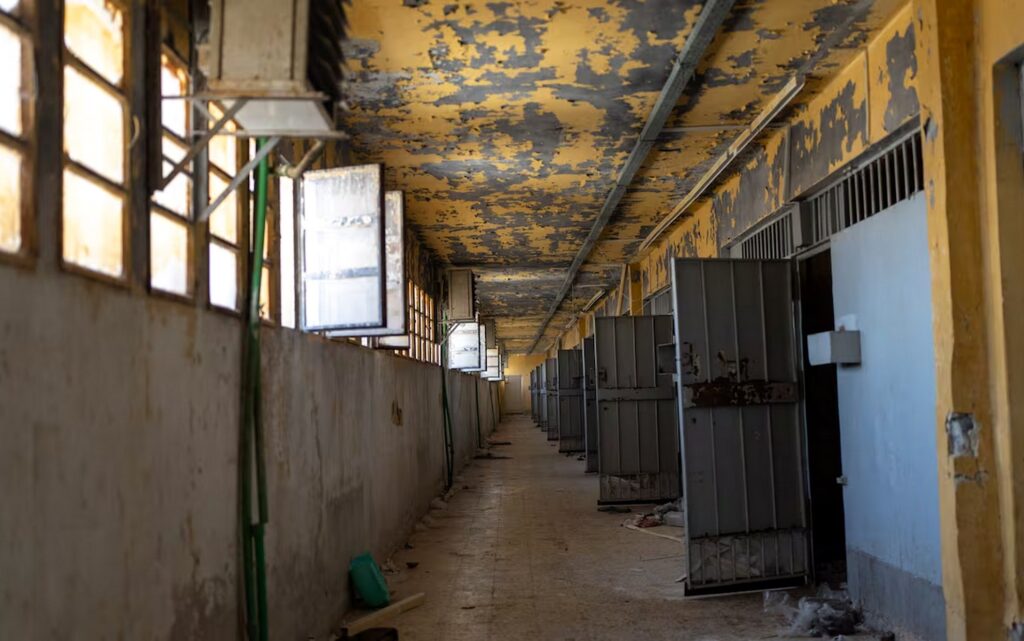
A Reuters investigation published on Monday revealed that a number of prisons that were symbols of repression during the rule of ousted President Bashar al Assad have returned to receive thousands of detainees, this time by the security forces of the Syrian transitional president, Ahmed alSharaa, without formal charges in many cases.
According to Reuters, detention centers previously known for their black record of torture and abuse have been reopened over the past year, despite previous pledges by the new leadership to close them and put an end to the practice.
Reuters indicates that the first waves of arrests began immediately after the victorious revolutionaries took control of the country and opened the gates of the former regime’s prisons, where thousands of soldiers and officers who withdrew from their positions were captured in conjunction with the storming of Syrian families into detention centers in December 2024 in search of their missing children.
The second wave occurred in late last winter, when the new authorities arrested hundreds of members of Assad’s Alawite community, most of whom are men.
The pace of arrests escalated significantly after limited unrest on the Syrian coast last March, which resulted in the deaths of dozens of security personnel.
This was followed by reprisals that killed some 1,500 Alawites, according to the investigation, while arrests continue to this day.
Reuters reported that another wave of arrests began last summer in the south of the country, in Druze-majority areas, following bloody sectarian violence in which hundreds were killed, with government forces accused of carrying out summary executions and serious abuses.
The investigation also documented arrests of Syrians from various sects, under the pretext of security reasons, including members of the Sunni majority, human rights activists, Christians, and Shiites who were accused of being associated with Iran or Hezbollah, or of unclear ties to the former regime.
Reuters has collected the names of at least 829 people detained on security grounds since the fall of the Assad regime a year ago, based on interviews with families of detainees and former detainees, as well as a review of lists prepared to organize family visits to seven detention centers.
The real number of detainees is likely much higher, Reuters said, pointing to the widespread phenomenon of financial extortion. Fourteen families said that intermediaries or people who presented themselves as prison guards demanded money in exchange for the release of their relatives, ranging from $500,000 to $15,000.
Families of former officers and influential figures under Assad, or people believed to be well-off, have reported receiving much higher financial demands, with six families reporting that the ransom demanded exceeded 1 billion Syrian pounds, equivalent to about $90,000.
The investigation revealed that at least 28 Assad-era prisons and detention centers have been reopened over the past year, including major prisons and large detention complexes that belonged to former intelligence services, as well as smaller checkpoints and police stations.
Reuters also reported that some of the detainees were transferred to prisons previously run by opposition factions, including detention centers that were previously under the control of forces led by President Ahmed al Sharaa himself in Idlib province, where they joined prisoners held for years on security grounds.
Reuters documented at least 11 deaths in custody, including three in which victims’ families weren’t informed of their sons’ deaths until after they were buried.
Reuters interviewed more than 140 people, including former detainees, lawyers, relatives of detainees and human rights activists.
It also reviewed correspondence between the families of detainees and people believed to be prison guards, as well as photographs of injuries caused by alleged torture.
Although it was unable to independently verify all the details, the agency confirmed that the accounts of those interviewed were very similar, particularly with regard to the ill-treatment.
Detainees and their families described the conditions of detention as inhumane, citing severe overcrowding, food shortages, and widespread skin diseases as a result of the lack of basic hygiene items, such as soap.
Dozens of people confirmed that neglect, ill-treatment, and sometimes torture were common practices in detention centers, both against those arrested for security reasons and those accused of ordinary crimes.
At least 80 families have lost contact with their detained relatives for months, the agency said, noting that access to lawyers or families varies from center to center, and that formal charges against security detainees are an exception rather than a rule.
Reuters pointed out that these conditions, while harsh, don’t reach the level of the systematic violations that characterized the Assad era, which saw the disappearance of more than 100,000 Syrians, according to Reuters estimates, and the mass graves left behind by that era are still being discovered today.
In response to Reuters inquiries, the Syrian Ministry of Information said that the need to hold accountable those involved in the abuses of the former regime explains part of the arrests and the reopening of some detention centers.
The Syrian Ministry of Information added that the scale of crimes and violations committed during Assad’s rule is very large, and that the country is going through the stage of institution-building and prison rehabilitation, stressing that the humanitarian situation has significantly improved compared to the past, despite acknowledging that the current reality is still far from the hoped-for level.
A senior administration official, in response to a question about prison conditions, said President Donald Trump is committed to supporting a united and stable Syria, living in internal peace and with its neighbors.
The spokesperson for the UN Human Rights Office, Thameen al Khaitan, told Reuters that it’s difficult to prepare an accurate record of security detentions in Syria at the moment, noting that determining the number of detainees or those released, or classifying some cases as enforced disappearances, is still very complicated, especially with some families reluctant to provide information for fear of consequences.