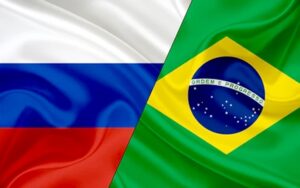
MEMO: USA x Russia: The eternal American hypocrisy

Provocations and reinforcement of internal controls are permanent… Let’s look at two cases.
Russia threatened in the G20 debate
On Monday and Tuesday, February 26th and 27th, representatives and secretaries of the Finance Ministers and Central Bank Presidents attended a preparatory meeting in the same location as the meeting of the G20 economic portfolio holders.
The meeting, which is part of the agenda of the Brazilian presidency of the G20, takes place this week at the Biennial Pavilion, in Ibirapuera Park, in São Paulo.
The Minister of Finance, Fernando Haddad, and the president of the Central Bank (BC), Roberto Campos NETO, represent Brazil.
On Monday, the Brazilian minister met with his counterpart, the Russian Finance Minister, Anton Siluanov, and with the managing director of the International Monetary Fund (IMF), Kristalina Georgieva.
The following day, the American provocation reached a point of almost no return.
US Treasury Secretary Janet Yellen said the move to send Russian assets to Ukraine is under study.
Siluanov, in turn, classified the American proposal to send Russian assets, blocked by sanctions, to Ukraine as a “fallacy” and “disaster”.
According to the Kremlin portfolio holder: “This is not the first time we have heard this proposal. We believe that this proposal is a profound and also destructive fallacy, because it undermines the very foundations and pillars of the world’s financial system, because it surrenders the value and reserves of money to vulnerable countries and susceptible to political decisions. The proposal (from the United States) would cause serious damage to the very foundations of the global financial system. As for our response, we have something to respond with, because we have [assets] frozen on our side. These decisions would not take us on the right path because, instead of escalating the situation, we need to de-escalate and reduce tensions. But if counterparties decide to continue down this path, we will respond symmetrically”.
Russian elections and Putin’s stay in power
The election day in Russia will be held from Friday, March 15th until Sunday, March 17th, the first time that a Russian presidential election will last three days.
If there is a second round of voting, if no candidate obtains more than half of the votes, it takes place three weeks later.
Any realistic assessment, both of Putin’s popularity and the conditions of competition for the position, indicates that it would be surprising for anyone to make it to the second round.
The Russian elections are only for the highest position in the Executive Branch, as the next legislative elections, which make up the Duma, are scheduled for 2026.
There is a similarity in the American elections.
There is early voting in remote areas or disputed territories in Ukraine.
There are four candidates for the most important post in the Russian Federation, and they are:
Vladimir Putin, 71 years old — the current president of Russia has held the position since 2012. Previously, he had been president (from 2000 to 2008) and prime minister (from 1999 to 2000 and from 2008 to 2012);
Leonid Slutsky, 56 years old — runs for the LDPR (Liberal Democratic Party of Russia). He is chairman of the international affairs committee of the Duma (Lower House of the Legislative Assembly);
Nikolay Kharitonov, 75 years old — member of the KPRF (Communist Party of the Russian Federation). In 2004, he came second in the presidential race, with 13.69% of the vote;
Vladislav Davankov, 39 years old — from the New People party. He is the deputy speaker of the Duma and deputy chairman of his party. He came fourth in the 2023 Moscow mayoral election, with 5.34% of the vote.
Permanent candidate: died or was killed?
On February 16, a Friday, the Russian government and Siberian criminal authorities confirmed the death of Alexey Navalny, a Russian far-right politician imprisoned since 2021 and Vladimir Putin’s most important opponent.
Navalny died under terrible prison conditions and under the care of the State… This is a fact… The other is that the West is elevating the status of martyr and political reference to someone who, if he were from Western Europe, would be aligned with the worst of the regional extreme right.
Even so, a prisoner protected by the prison administration died under real suspicion of poisoning, and obviously, it’s not the first.
We have to ask something obvious. Given the — irrefutable — evidence that the Putin government operates from the control of central institutions, one would expect an opposition that defends both internal democracy and national sovereignty based on the management of strategic resources.
Correct?
Wrong!
Since Boris Yeltsin’s government and the subsequent rise of the security apparatus (as we stated in the last article) there has been enormous — and fully justified — distrust that pro-Western democrats represent the delivery of the country’s capabilities in all strategic sectors.
Is a democratic and sovereign country possible?
Yes, obviously yes.
Does the Western-backed opposition against Russia promote alternatives that respect national sovereignty and material living conditions?
Of course not.
Does the United States not interfere in elections abroad?
The emblematic case of Honduras
José Manuel Zelaya Rosales was overthrown by a civic-military coup on June 28, 2009.
Just on Sunday morning, the day on which a consultation was called regarding the need or not for a National Constituent Assembly, the president elected by the Liberal Party from Honduras (PLH), was surrounded in his residence and taken to Costa Rica.
From that day until his return to the country on September 22, 2009, Zelaya carried out intense diplomatic activity trying to save his constitutional government.
In the following decade, more fraud.
As if changing the rules of the game with the match in progress was not enough, Juan Orlando Hernández (JOH) ran against Salvador Nasralla, from the Liberal Party and political nominee of Zelaya Rosales.
The illegitimate president was losing in the vote count when there was a very suspicious electrical blackout in the country, interrupting the manual counting of paper ballots.
As a consequence, the Supreme Electoral Court of Honduras (TSE) suspended the announcement of the winner.
After 17 days, the electoral court dominated by JOH supporters and supporters of the 2009 coup recognized the victory of the situation, converting Honduras into an authentic civil dictatorship.
The United States supported both the 2009 coup and the rigged election in 2017.
History repeats itself just like in Panama of CIA agent and drug trafficker Manuel Noriega.
The brother of the president of Honduras, Juan Orlando Hernández, was sentenced on March 30, 2021 to life in prison by a New York judge for large-scale drug trafficking.
Tony Hernández, 42, was found guilty in October 2019 after a trial in which American prosecutors said the Honduran head of state had conspired in drug trafficking, an accusation he denies.
Former president Juan Orlando Hernández was extradited in April 2022, two months after leaving power, Hernández is accused of having ties to a criminal network that sent more than 500 tons of cocaine to the United States between 2004 and 2022, and of protecting their criminal activities.
In return, he would have received “millions of dollars” from drug cartels — including Mexican drug lord Joaquín “Chapo” Guzmán, sentenced to life in prison in the United States.
The Result… The United States of America supported a coup d’état, recognized fraudulent elections and then arrested the criminals that the Empire itself had supported internationally.
Could anything be more hypocritical? Obviously not.
The original article here.