Israeli Poll: Bennett and Eisenkot outperform Netanyahu for prime minister
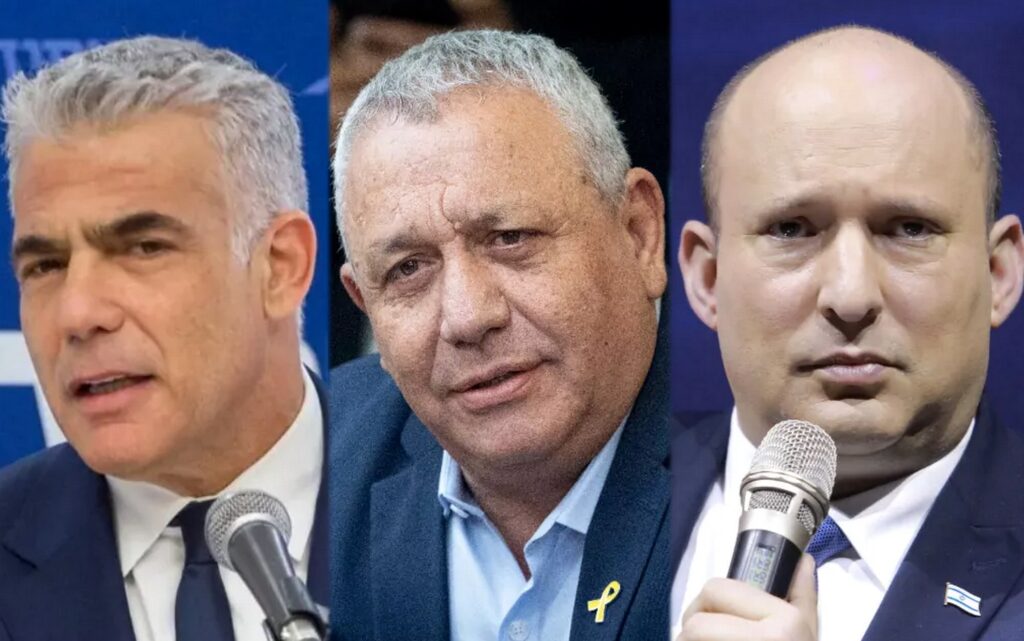
An Israeli public opinion poll released Friday showed that former Prime Minister Naftali Bennett and former army chief of staff Gadi Eisenkot are ahead of Prime Minister Benjamin Netanyahu for the premiership in any upcoming election.
This comes according to a survey conducted by the private Lazar Institute, which included a random sample of 501 Israelis, with a margin of error of 4.4%, and whose results were published by Maariv newspaper.
According to the poll results, 46% of Israelis believe that the leader of the Together party, Bennett, is the most suitable to head the government, compared to 41% who favored Netanyahu, while 13% said they didn’t know.
The poll added that 44% believe that Eisenkot is the most suitable for the position, compared to 42% for Netanyahu, and 14 percent don’t know.
When asked to choose between Eisenkot and Bennett, 33% said that Eisenkot was the most suitable candidate to head the government, compared to 32% who preferred Bennett, and 35% who didn’t know.
This poll is the first since the announcement days ago that the Bennett 2026 party, headed by Bennett, and the Yesh Atid party, headed by opposition leader Yair Lapid, would merge into the Together party to contest the general elections next October if they are held on schedule.
The two merged parties left the door open for Eisenkot’s party to join Together.
According to the poll, the Together party has become the largest in Israel with 28 seats, followed by the Likud party headed by Benjamin Netanyahu, which only got 26 seats.
This is the first time in many months that a party has overtaken Likud, as in Israel, prime minister post isn’t elected directly by the people, but rather the position is held by whoever is able to form a government that enjoys the confidence of at least 61 of the 120 members of the Knesset.
Despite their lead, the poll indicated that Israeli opposition parties didn’t obtain the 61-seat majority required in the Knesset to form a government.
He stated that the opposition parties would win 60 seats, compared to only 50 seats for Netanyahu’s camp, and 10 seats for the Arab members of parliament.
This means that it’s still unable to achieve a majority to form the next government, especially since Bennett and Lapid have repeatedly stated that they won’t form an alliance with Arab members of parliament for that purpose.
But they had previously relied on the support of the United Arab List, headed by Mansour Abbas, to form a government in 2021, which soon fell the following year.
On Wednesday, more than 80 Arab and Jewish peace organizations attacked the positions of Bennett and Lapid, after they announced their refusal to form a coalition with Arab members of parliament to form a government.
The organizations stressed in a statement that Arabs are an integral part of any future solution, and that a political settlement with the Palestinians cannot be achieved while simultaneously excluding the Arab community within Israel.
Recent public opinion poll results showed that the Israeli opposition would need Arab members of parliament in order to form a government, if elections were held today.