Foreign Affairs: America’s decline in soft power increases China’s global influence
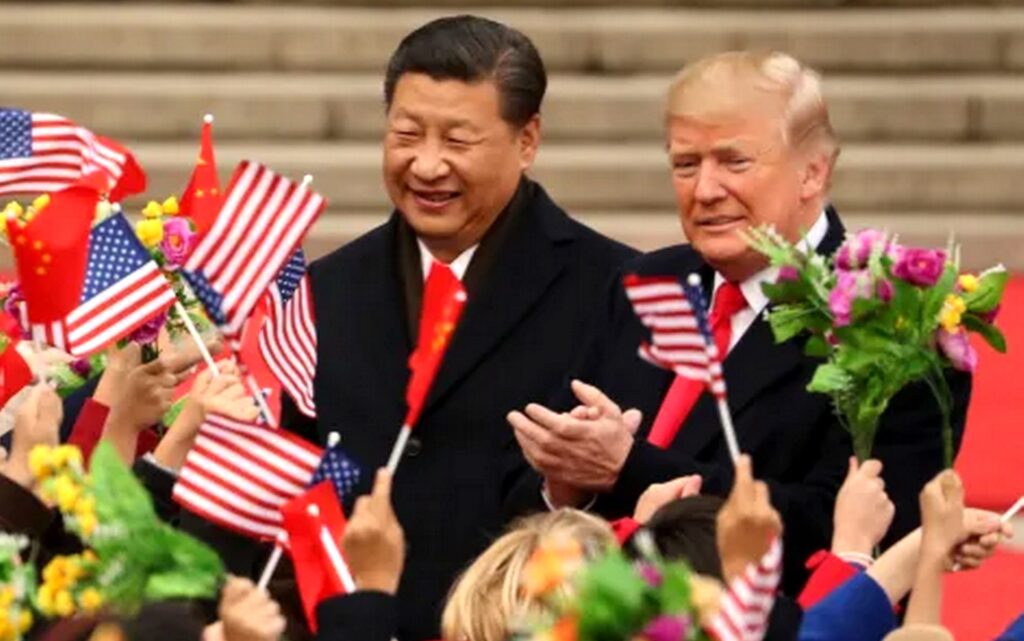
As the US role in soft power has diminished since President Donald Trump’s second term began, many observers have turned their attention to China, which today is emerging as the biggest beneficiary of this widening vacuum in the international system.
For many years, American institutions that had been Washington’s pillars of global influence have disintegrated, while Beijing has seemed more present and able to reach the Global South, thanks to its economic offerings and its cultural and technological expansion.
Despite this remarkable shift in the balance of international gravity, Maria Rybnikova, a professor of global communications at Georgia State University, argues that China isn’t acting as a rising power seeking to inherit the US role, but rather as a cautious force that measures its steps accurately, avoiding engaging in broad commitments or offering an alternative ideological model.
In this context, Beijing appears to be benefiting from Washington’s retreat but isn’t necessarily ready to lead the world or formulate a new vision for the international order.
The radical shift in US foreign engagement since the beginning of Trump’s second term.
US institutions that were the pillars of soft power, such as the US Agency for International Development and the State Department’s public diplomacy programs, have shrunk or disappeared.
Tight immigration restrictions also take away from the US attractiveness and traditional openness, especially since China allows citizens of more than 70 countries to enter visa-free for 30 days.
Moreover, US diplomacy of a coercive nature based on persuasion and purely commercial transactions has caused its allies to become increasingly alienated.
Some observers, such as the former NATO official, have described these policies as “soft power suicide,” while Joseph Nye, who coined the term soft power, warned that China stands ready to fill the vacuum.
The idea that the competition between China and the United States in the field of soft power is based on a zero-sum equation is inaccurate.
China and the United States, offer different but mostly complementary models of influence.
China tends to attract other countries by offering practical benefits in trade, infrastructure, loans, and training programs.
By contrast, the United States has been putting the principles of democracy, human rights, and liberal ideals at the heart of its efforts to reach out to the world, which in its view has led many countries, especially in the Global South, to accept the offers of both sides at the same time.
While the US cut its development aid to countries has made China’s commitments appear to be the largest globally, while Beijing isn’t expanding these commitments to fill the US vacuum.
By a Chinese lecturer in response to an Ethiopian official’s question: “We’re not here to give advice”.
On the contrary, China is reducing the size of its financial pledges.
Its latest pledge of $9.2 billion to Latin American and Caribbean countries in 2025 is 50% less than its pledge in 2015.
Its loans at the SCO have fallen from $5 billion in 2014 to just $1.4 billion in 2025.
China isn’t seeking to replace USAID in the humanitarian field or support good governance.
Its foreign aid budget remains modest and relies on concessional loans, and hasn’t increased significantly since the shrinking US role.
Even in areas where they are expanding, such as investing in the Middle East and Latin America, private companies, not the state, are the main drivers.
On the ideological level, there are no signs that China is looking to offer an alternative governance model that rivals the US model, which has a declining presence abroad.
Chinese President Xi Jinping’s message essentially calls for a “more just world order” and focuses on differentiating from the West and rejecting Western hegemony, rather than offering a clear worldview or a “Chinese model” ready for export.
Through research into China’s training programs for African officials, Chinese lecturers praise Beijing’s successes, describing their system as a “more efficient version of democracy” but rarely provide guidance on how to emulate the Chinese experience.
As an example, at a seminar in Addis Ababa, when an Ethiopian official asked for advice on how to apply China’s experience in fighting poverty, the Chinese response was “we aren’t here to give advice,” ending the discussion.
China is experiencing a cultural and technological boom that enhances some elements of its soft power, from Labubu dolls to the animated film Ne Zha 2 to artificial intelligence platforms like Deep Seek.
These products have led some observers to say that “China has become attractive”.
While these phenomena promote friendliness toward Beijing, they don’t offer an integrated political or global vision.
Opinion polls suggest that China has made tangible gains, but its heterogeneous.
China’s negative image is entrenched in Europe and the Asia-Pacific region, where security concerns outweigh economic temptations.
In a poll conducted by the Pew Research Center, 66% of respondents in 25 countries expressed distrust in the Chinese president’s ability to make the right decisions in world affairs.
Even officials in Africa, while appreciative of Chinese loans, always wonder whether Beijing’s offer is a win-win for both sides or only for China.
China’s current gains as relative and far from pivotal, as Beijing benefits from the US backsliding negatively, but avoids over-expanding or engaging in ideological policies beyond its borders.
Rather than replacing Washington, China seems content to dedicate its own course, take advantage of highlighting its differences with the United States, and maintain a great deal of flexibility in its diplomacy.