Three names from the SDF may take up positions in the Syrian defense while SDF still has doubt regarding merging its forces with Syrian government
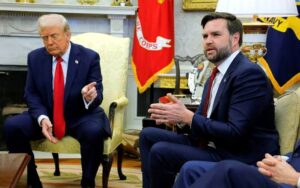
With the visit of Syrian transitional President Ahmed al Sharaa to the United States and his meeting with US President Donald Trump last Monday, the talk returned to the March 10 agreement between Sharaa and Mazloum Abdi, the commander of the Syria Democratic Forces (SDF).
This agreement comes in the context of Damascus’s announcement of the possibility of signing an agreement under which it will join the international coalition led by Washington against ISIS.
Meanwhile, a new round of negotiations is expected between Damascus and the SDF, following the return of Sharaa and its foreign minister Asaad al Shaibani from Washington.
The meeting is scheduled to be held in the Syrian capital to follow up on the implementation of the terms of the March 10 agreement, which the Syrian Foreign Ministry also confirmed in an official statement.
The negotiations were scheduled earlier this month, but that the visit of Sharaa and his foreign minister to Washington led to postponement.
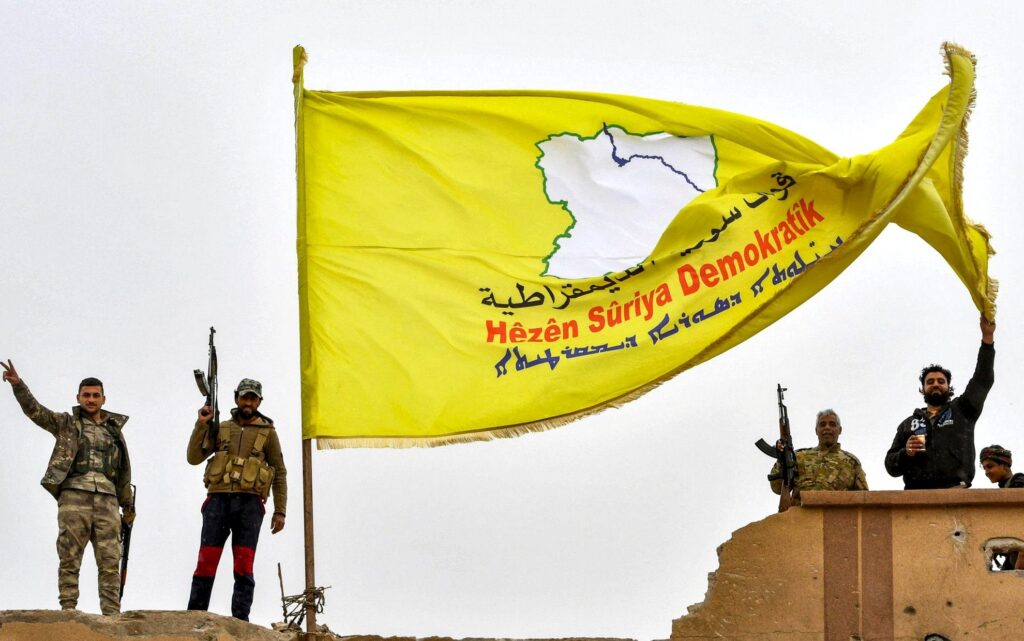
Sources from the SDF revealed that three of its military commanders may be included in the Syrian Ministry of Defense as part of the process of integrating the SDF as a unified bloc in the Syrian army.
According to SDF sources, the current Syrian army will form divisions and brigades, and the SDF will be included through at least one division and two divisions.
The nominated commanders are: Lokman Khalil, Jia Kobani, and Jamil Kobani.
US officials are expected to participate in this round of negotiations between the SDF and Damascus, especially if Syria’s formal accession to the international coalition to fight ISIS is confirmed.
In its initial talks, Damascus proposed the inclusion of the SDF in its armed forces through this temporary structure (division and brigades), provided that the arrangement would change later according to what will be approved by the permanent constitution, especially if a decentralized system is approved as demanded by the Syrian Democratic Forces.
For its part, the Syrian Foreign Ministry announced that Shaibani met during his visit with US and Turkish officials, and it was agreed with them to proceed with the implementation of the March 10 agreement.
This agreement stipulates the integration of the SDF’s civilian and military institutions into the Syrian army, the fight against remnants of the former regime, the rejection of calls for the partition of the country, the sharing of oil resources, the management of border crossings and the Qamishli International Airport, and the recognition of the Kurdish component of the state.
Its noteworthy that the SDF submitted to Damascus about two weeks ago a list of about 70 of its commanders, both men and women (from the Women’s Protection Units), to assume positions in the Ministry of Defense and the General Staff of the new Syrian government.
However, some differences remain: after the agreement was signed last March, all seven of its clauses haven’t yet been implemented, according to the sources.
In this regard, Abdel Salam Ahmed, representative of the Democratic Autonomous Administration for North and East Syria, stated that the integration of the Syria Democratic Forces (SDF) into the Syrian army isn’t possible at the moment without the formation of a unified Syrian army.
Ahmed explained that the talk of integrating the SDF into the Syrian army as currently proposed by the Syrian government cannot be implemented for fundamental reasons, most notably that Syria currently lacks a unified military structure in which any faction can be integrated.
He pointed out that what has been described as the creation of a new army is in fact merely an attempt to unify the paramilitary formations and the various armed groups, without building a true national military institution with a unified doctrine and central leadership.
Ahmed added that the integration process cannot be set on a timetable, as it is not only related to military aspects, but mainly depends on the emergence of a unified national political framework.
He stressed that before discussing any mechanisms of merger or unification, basic issues such as redrafting the constitutional declaration, defining a comprehensive governance model and mechanisms for interaction between the center and the regions, in addition to forming a legitimate transitional authority capable of leading the next phase and overseeing the construction of a unified army.
Regarding ensuring the security of the Kurds in northern and eastern Syria, Ahmed pointed out that this issue shouldn’t be left to circumstances, but should be based on three basic elements: a comprehensive and legitimate transitional authority that controls all armed forces, local security structures to protect the community within a decentralized state system, and international guarantees that no use of force or reprisals will be subjected to any acts.
He concluded by saying that this model is the only one capable of preventing the recurrence of the tragic events that the residents of some Syrian regions such as the Syrian coast region and Suwayda have been subjected to.