Tensions continue in the Libyan capital as demonstrations continue for the second day in a row
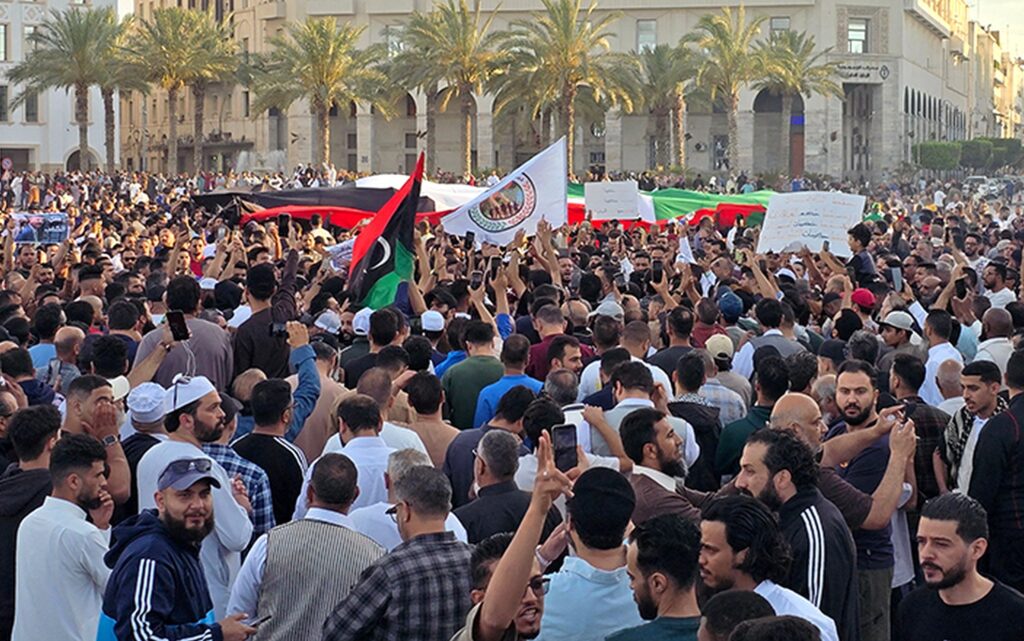
Hundreds of Libyans took to the streets on Saturday to demand the departure of Abdul Hamid Dbeibah, head of the internationally recognized Government of National Unity.
They gathered in Martyrs’ Square in the center of the capital, which has been rocked by three days of violence this week.
According to the United Nations, the clashes, which began Monday night and involved the use of heavy weapons and artillery, resulted in the deaths of eight people.
The clashes began when the 444th Brigade, affiliated with the Ministry of Defense, launched a military operation targeting the Stability Support Apparatus, leading to the death of its leader, Abdul Ghani al Kikli.
Abdul Ghani al Kikli was the most prominent leader of the armed groups that have wielded significant influence in Tripoli since 2011, and which the government is attempting to dismantle.
In his first public appearance since the outbreak of violence, Prime Minister of the Government of National Unity, Abdul Hamid Dbeibah, received dignitaries from Tripoli and a delegation of prominent figures from his hometown of Misrata.
In a statement, Dbeibah affirmed his government’s efforts to find a quick solution to the violence by deploying its security forces, calling on protesters to support the state’s efforts to avoid any return to chaos and the rule of armed groups.
Meanwhile, Khaled al Mishri, head of the High Council of State, announced the start of consultations with the eastern-based parliament to select a national figure to form a new government.
Since the fall of Muammar Gaddafi’s regime in 2011, Libya has been experiencing security and political instability, with its affairs being run by two rival governments: one in Tripoli in the west, headed by Abdul Hamid Dbeibah, and the other in Benghazi in the east, headed by Osama Hammad, which enjoys the support of Parliament and Field Marshal Khalifa Haftar.