Israel: The Mossad announces bringing back the archive of spy Eli Cohen from Damascus as the Syria authorities express its readiness to hand over his body
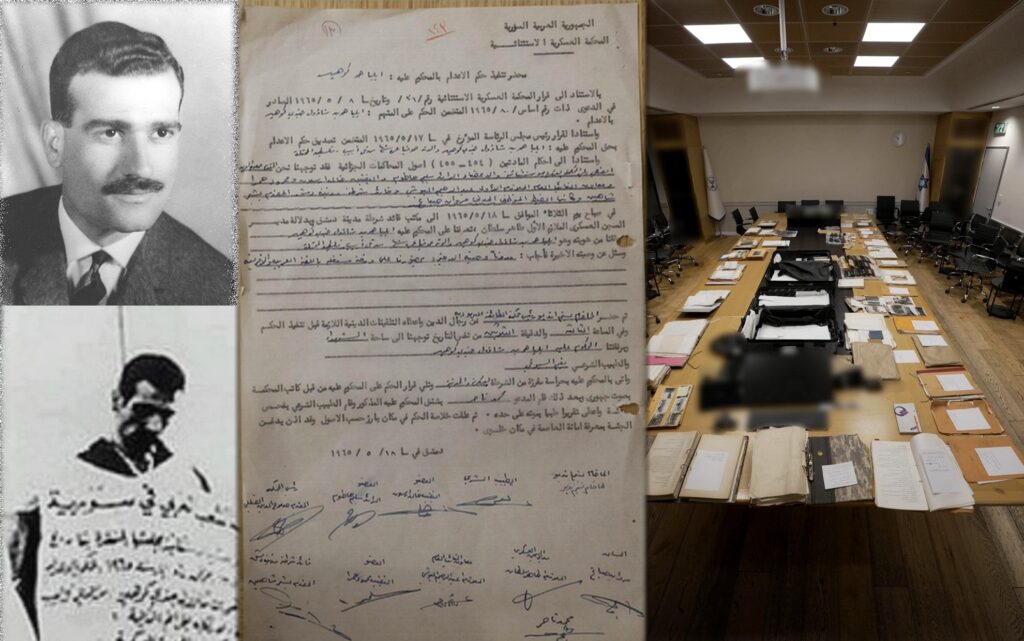
The Israeli Prime Minister’s Office announced on Sunday that the Mossad carried out a secret operation with a friendly” intelligence agency to bring the official Syrian archive of Israeli spy Eli Cohen to Tel Aviv.
According to a statement issued by Netanyahu’s office on behalf of the Mossad, the archive was brought to Israel from Damascus and contains more than 2,500 documents, photos, and personal belongings belonging to the Israeli spy, who was executed in Martyrs Square in Damascus in 1965.
He added, in a statement, that the materials, which he described as the official Syrian archive, had been held by Syrian security services since Cohen’s execution in 1965, and were recently recovered in a secret operation with a strategic partner intelligence agency, on the eve of the sixtieth anniversary of his execution.
Mossad said the material includes Cohen’s handwritten will, recordings from his interrogations, photos, family correspondence, and personal belongings, a large portion of which is being shown for the first time.
The documents, according to the statement, also include details of Cohen’s intelligence activities in Syria, including missions to track and document military installations, in addition to a copy of the court ruling that sentenced him to death.
The statement indicated that this step falls within the framework of ongoing efforts to uncover Cohen’s fate and burial place.
The statement said, “Among Eli Cohen’s personal belongings were found keys to his apartment in Damascus, forged passports and documents he used, as well as numerous photos from his time in secret activity in Syria, including photos of Cohen with senior officers, generals, and officials in the Syrian regime”.
The statement added, “In his notebooks and diaries, which were confiscated by Syrian intelligence from his home after his arrest, instructions were found that he received from Mossad to carry out secret missions, including one to track a specific target and another to gather intelligence on Syrian military bases in Quneitra”.
The statement continued, “The original copy of the court ruling and the order to execute him was also found… The document states that the head of the Jewish community in Damascus at the time, Rabbi Nissim Andibu, was permitted to accompany him in accordance with Jewish religious tradition”.
The statement continued, “Among the files found in the archive was a large orange folder titled ‘Nadia Cohen’ A review of the file reveals that the Syrian intelligence service tracked all of Ms. Cohen’s activities to demand her husband’s release from Syrian prison, including the numerous letters she sent to world leaders and the Syrian president”.
The statement concluded with statements from Prime Minister Benjamin Netanyahu and Mossad chief David Barnea, expressing the importance of this step from a symbolic and intelligence perspective, and describing the operation as part of the state’s commitment to returning its missing and captured soldiers.
On the same context, a political Israeli sources said on Friday that the new government in Damascus is taking far-reaching steps to influence and change Israel’s hostile policy.
These steps include direct meetings between high-ranking Israeli security officials and their counterparts from the new Syrian government in recent months.
According to Israeli Maariv newspaper, the Syrians informed the Israelis that they were seeking to locate the remains of the spy Eli Cohen, who was executed in Damascus in the mid-1960s.
This came as a stunning surprise to them, who viewed it as a serious attempt to offer a gesture that would undoubtedly have a profound impact on Tel Aviv.
On this regard, Haaretz newspaper reported in a report published Friday that senior Israeli security officials have met in recent months with their counterparts in the administration of Syrian transitional President Ahmed al Sharaa, adding that the meetings are being held at the initiative and with mediation from Qatar.
Haaretz report quoted an unnamed source, who it said was from the region, as saying that the meetings focused on initial acquaintances, with the aim of establishing an axis to convey messages and prevent escalation in the region.
The report noted that while Israel publicly acts with suspicion toward the new Syrian administration, “Qatar and other countries are sending messages to Israel that they aren’t seeking confrontation or escalation with Israel, and that this suspicion is baseless”.
The Israeli newspaper linked this news to US President Donald Trump’s meeting with the Syrian transitional president in Riyadh on Wednesday and the agreement to lift sanctions on Syria.
Meanwhile, Israel is currently conducting secret talks with the Syrian administration, as part of a regional process mediated by the UAE.
It was reported that one of the most important meetings was recently held in Azerbaijan, as the head of the Israeli army’s operations division, Oded Basyuk, met during the meeting with representatives close to the Syrian transitional president, along with the attendance of Turkish officials.
Reports recently indicated that Israeli Prime Minister Benjamin Netanyahu, during his visit to the United States last month, had asked Trump to maintain US sanctions on Syria and not support stability there, citing his fear of a repetition of what happened on October 7, 2023.
At the same time, however, he agreed to send his men to negotiate with Damascus, as on the 7th of May, the Syrian transitional president said that Damascus was conducting indirect negotiations through mediators with Tel Aviv in an attempt to absorb the situation and prevent a loss of control in light of Israel’s continued violations of the 1974 Disengagement Agreement and its escalating attacks.