Highlights of the press conference between the French President and his Syrian counterpart in Paris
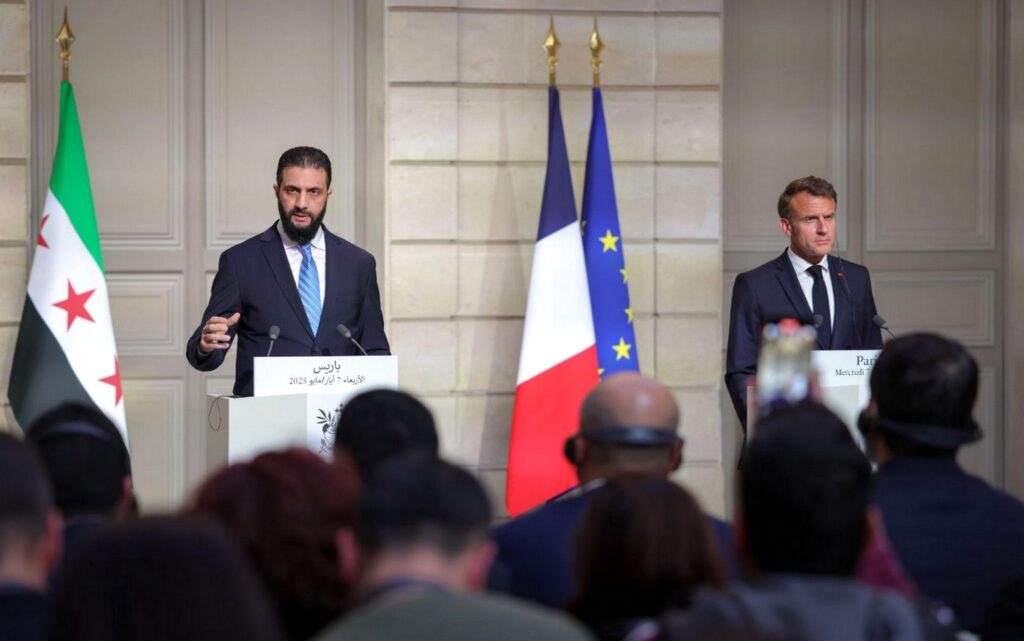
Syrian Transitional President Ahmad al Sharaa revealed on Wednesday that his administration is conducting indirect negotiations with Israel through mediators to calm the situation between the two sides.
This came during a press conference he held with his French counterpart, Emmanuel Macron, as part of an official visit to Paris, his first to a European country since assuming office.
Ahmad al Sharaa said, “We’re conducting indirect negotiations with Israel through mediators to calm the situation, so that matters don’t reach a point where both parties lose control”.
He added, “Israel bombed Syria more than 20 times last week, and it must stop its arbitrary actions and interference in Syrian affairs”.
He pointed out that he had spoken with all parties that Syria is committed to the 1974 agreement the disengagement agreement with Israel”.
Although the new Syrian administration, headed by al Sharaa, hasn’t threatened Israel in any way, Tel Aviv has been launching airstrikes on Syria on an almost daily basis for months, killing civilians and destroying Syrian military sites, vehicles, and ammunition.
“The Syrian people refused to submit to the rule of tyranny,” al Sharaa said, adding, “We carried out our combat actions with honor and integrity until Syria was liberated”.
He stated that France has been a friend of the Syrian people and has stood by them throughout the years of the revolution.
He noted that he and Macron discussed today ways to advance issues of mutual interest, as well as France’s contribution to the reconstruction and stability of Syria, which represents the stability of the entire region.
He stated that he also discussed with the French President prospects for cooperation in the areas of security, economy, achieving justice, and combating terrorism.
The Syrian transitional president expressed his gratitude to President Macron and the French people for welcoming Syrian refugees over the past years and for welcoming me today.
Regarding the events in the Sahel region in March following attacks by outlaws, al Sharaa said, “We moved quickly to confront these tragic events, which were perpetrated by armed men affiliated with the former regime… We formed a committee to investigate these events, and the Human Rights Council welcomed it”.
He stressed that his administration “won’t allow sectarian strife or the violation of Syria’s sovereignty by external parties,” adding, “Syria’s future won’t be shaped in closed rooms or decided in distant capitals”.
Regarding the international sanctions imposed on his country, al Sharaa explained that they were imposed on Syria because of the crimes of the former regime, and there is no justification for their continuation after its demise.
He stated that he discussed with Macron the border situation with Lebanon.
When asked about the future of foreign fighters in his country, al Sharaa explained that the Syrian constitution will determine the rights of foreign fighters and their families to obtain citizenship, noting that some of them have married Syrian citizens and have contributed to liberating the country from the Assad regime.
In response to another question, he stated that Syria “was the country most exposed to terrorism by the former regime, and that it stands in solidarity with victims of terrorism everywhere… We’ve no connection to any criminal activity outside Syria”.
For his part, French President Emmanuel Macron stressed that Israel would not be able to guarantee its security by “violating” the territories of neighboring countries.
In this context, Macron said: “I don’t believe that you can guarantee your security by violating the territorial integrity of your neighbors”.
Macron stressed that France has a long history with Syria, and that his country has consistently supported the aspirations of the Syrian people since 2011 to build a unified and free Syria in which all citizens are equal regardless of their origins, religion, or social status.
Macron stressed the need to pursue international justice for the horrific crimes committed by the ousted Assad regime.
He continued, “The fall of Bashar al Assad was a source of relief and joy for all of us… Now, the new Syrian leadership must overcome an extremely difficult situation: finding a path back to peace and popular unity… We want a peaceful transition that includes all components of Syrian society”.
Macron spoke about the recent events in Druze areas in Syria, stressing that he had asked Sharia law to protect all Syrians unconditionally and hold those responsible accountable.
He stressed that Syria cannot regain stability without economic recovery and infrastructure improvements, explaining that Syrians, including those abroad, want to contribute to their country’s reconstruction.
He pointed out that the European Union will continue to gradually lift sanctions imposed on Syria as part of its reconstruction, stressing the need to encourage the United States to do the same.