Trump issued warnings to BRICS countries against ditching the US dollar
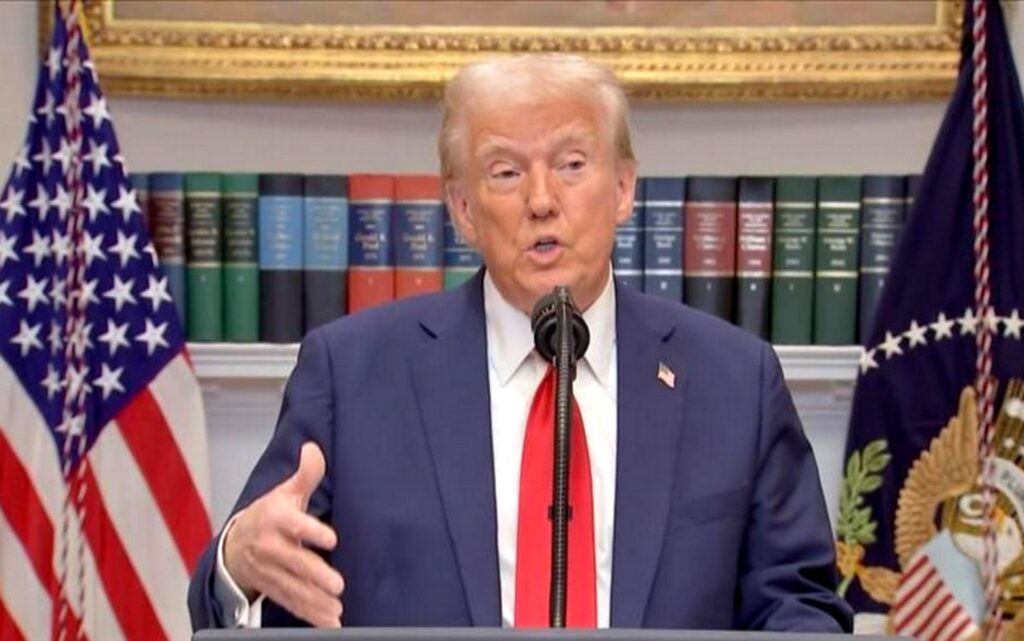
US President Donald Trump warned BRICS countries on Thursday against trying to replace the dollar as a reserve currency, renewing his threat to impose 100% tariffs, a threat he first made weeks after winning the presidential election in November.
In a statement posted on his Truth Social platform, Trump reiterated his previous positions on the BRICS group, saying,
“We’ll demand a commitment from these apparently hostile countries not to launch a new BRICS currency, and not to support any alternative to the almighty US dollar, or they will face 100% tariffs”.
In contrast, the BRICS group has stressed that it has no plans to abandon the dollar or issue a single currency at the present time.
Russia, a member of the group, has indicated that any American attempt to force countries to use the dollar could lead to counterproductive results.
BRICS comprises Brazil, Russia, India, China and South Africa, and is set to expand to include Egypt, Ethiopia, Iran and the United Arab Emirates in 2023.
Earlier this month, Indonesia became a new member.
In addition to his warnings to BRICS, Trump has stepped up his rhetoric toward Canada and Mexico, both of which are awaiting his decision on his pledge to impose 25% tariffs starting February 1.
The threat is part of Trump’s plan to use tariffs as a tool to pressure the two countries to help stem the flow of drugs, particularly the deadly fentanyl, as well as to curb illegal immigration into the United States.
Despite international trends towards reducing reliance on the dollar, the US currency still maintains its dominant position globally.
The strong US economy, along with tight monetary policy and geopolitical risks, have strengthened the dollar’s position as a major reserve currency.
According to a study by the Atlantic Council’s GeoEconomics Center, the US dollar remains the primary global reserve currency, as neither the euro nor the BRICS economies have been able to reduce global dependence on it.
The term BRIC dates back to 2001 when Jim O’Neill, chief economist at Goldman Sachs, coined it to refer to the emerging economies with high growth potential: Brazil, Russia, India and China.
The bloc was founded in 2009 as an informal forum to counter Western dominance, and South Africa joined in 2010 to become BRICS.
As debate continues over the future of the global financial system, BRICS remains challenged by the US, with questions raised about its ability to achieve its economic ambitions away from the influence of the US dollar.