The latest developments in the Moroccan earthquake: the death toll reaches 2000, with thousands injured… hundreds trapped under the rubble calling for help and survivors living on the streets
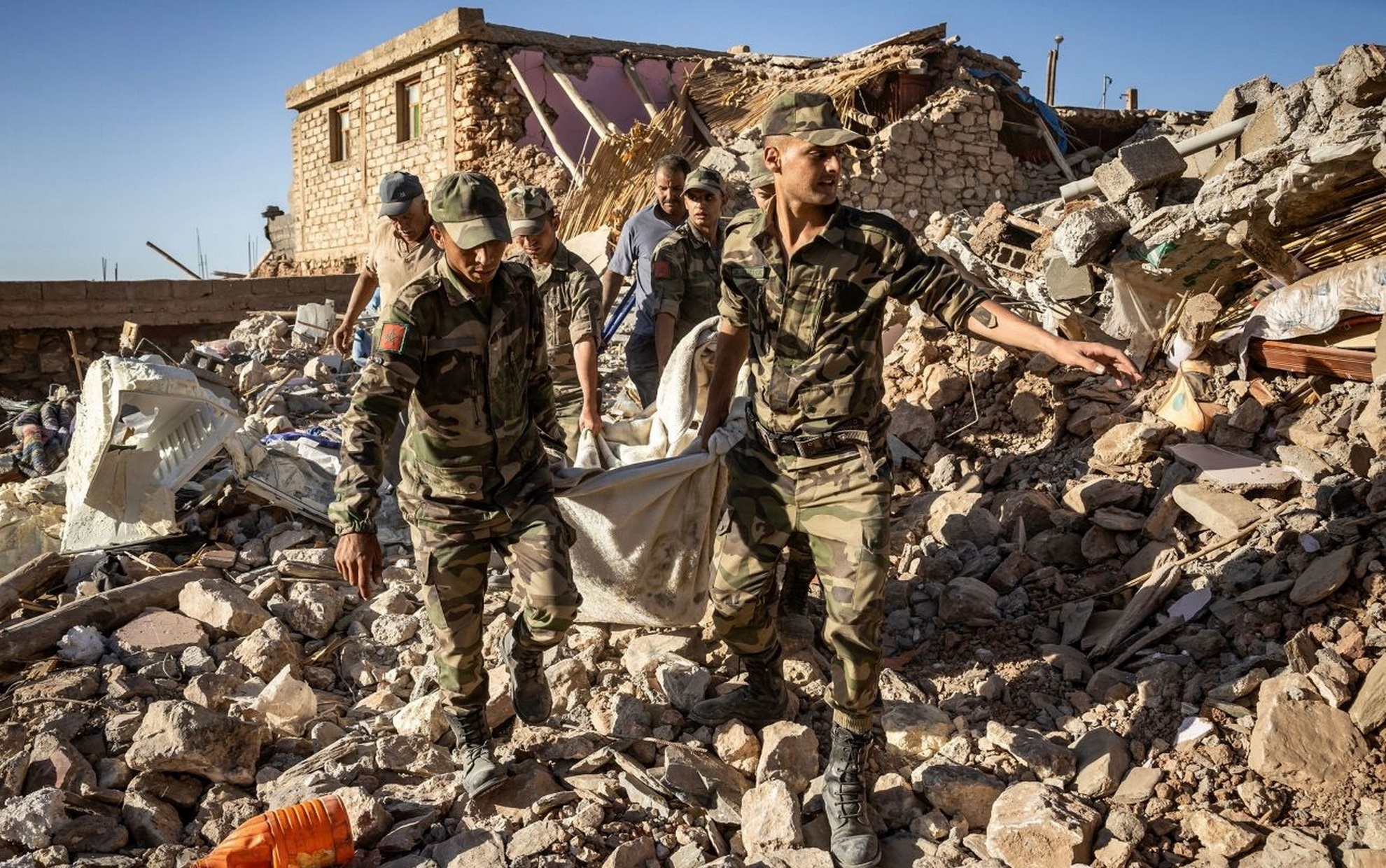
Survivors of the earthquake that struck Morocco gathered to spend the night in the open air of the High Atlas Mountains region on Saturday, a day after the most violent earthquake the country has witnessed in more than six decades, which claimed the lives of more than 2,012 people and destroyed a number of buildings.
Residents are still searching for survivors under the rubble of their homes that they built on the slopes of mud bricks, stones and rough wood before they were toppled by the earthquake that occurred late on Friday evening, causing the minarets of several mosques to fall and causing serious damage to the historic old city of Marrakesh.
The Moroccan Interior Ministry said that 2,012 died and 2,052 were injured in the earthquake, which the US Geological Survey determined at 6.8 and whose epicenter was about 72 kilometers southwest of Marrakesh, and among the injured, 1,220 are in critical condition.
The earthquake, which occurred around 11:00 PM, local time (2200 GMT) Friday night, affected a large area in the High Atlas Mountains region.
Residents of the cities of Huelva and Jaén in the Andalusia region in southern Spain felt the tremors.
The World Health Organization said that more than 300,000 people were affected by the earthquake in Marrakesh and its surrounding areas.
Videos taken from the streets in Marrakesh showed the moment the ground began to shake as men suddenly looked around and jumped from their places, while others ran for cover in an alley and then fled after dust and debris fell around them.
The minaret of a mosque fell in Jemaa El Fna Square, the heart of the old city of Marrakesh, which is listed on the United Nations Educational, Scientific and Cultural Organization (UNESCO) World Heritage List.
In a statement issued this evening, the Royal Court announced three days of mourning, adding that the national flag will be flown at half-mast throughout the country.
The statement added that the Moroccan Armed Forces will deploy rescue teams to provide the affected areas with clean drinking water, food supplies, tents and blankets.
The Supreme Command of the Armed Forces deployed important human and logistical means, air and land, in addition to specialized intervention units consisting of search and rescue teams, and a field medical and surgical hospital.
The Moroccan Royal Court stated, in a statement, that the King gave his instructions from the first moments to strengthen means and rescue teams in order to speed up the process of rescuing and evacuating the wounded, and ordered that the earthquake victims be taken care of and that an account be opened to receive solidarity contributions.
The Ministry of Endowments and Islamic Affairs also announced that “after noon prayers, Sunday, in all mosques of the Kingdom, prayers in absentia will be held, out of mercy for the souls of the martyrs of the earthquake”.
Footage broadcast on state television from the Moulay Ibrahim region, about 40 kilometers south of Marrakesh, showed dozens of houses collapsed at the foot of a mountain and residents digging graves while groups of women stood in the street.
Governments around the world expressed their solidarity and offered assistance.
Türkiye, which was also hit by a strong earthquake in February that killed more than 50,000 people, announced that it was ready to provide assistance.
Algeria, which severed ties with Morocco last year, said it would open its airspace to humanitarian and medical flights.
The earthquake occurred at a depth of 18.5 kilometers, so it’s more destructive than earthquakes that are of the same magnitude but whose epicenter is at a deeper distance.
This earthquake is the worst in terms of the number of victims in Morocco since 1960, when an earthquake occurred and killed at least 12,000 people, according to the US Geological Survey.
In Marrakesh, where debris littered the streets, residents described tragic scenes of people seeking safe haven.
In the capital, Rabat, about 350 kilometers north of Ighil, and in the coastal town of Imsouane, about 180 kilometers west, residents also fled their homes for fear of a stronger earthquake.
In Casablanca, about 250 kilometers north of Iguil, people who spent the night on the streets were too afraid to return to their homes.