New York Times: Venezuelan navy defies Trump’s threat of blockade

Pentagon officials, surprised by President Trump’s orders, rushed to devise a plan to stop sanctioned oil tankers, and Nicolás Maduro vows to resist.
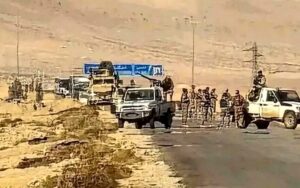
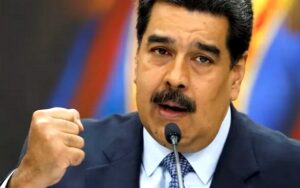
Venezuelan leader Nicolás Maduro has ordered his navy to escort ships loaded with petroleum products from the port, risking a confrontation with the United States on the high seas, in defiance of President Trump’s announcement of a “blockade” of Venezuela’s oil sector.
Three sources familiar with the crossings said several ships sailed from Venezuela to Asia accompanied by the Venezuelan navy between Tuesday evening and Wednesday morning.
None of these commercial vessels are on the list of sanctioned oil tankers that the United States threatens to target.
But the recent series of events, which began with the Trump administration’s seizure of an oil tanker last week and then the president’s order of a partial “blockade” on Tuesday, has raised the prospect of violent conflict.
In the months since Trump launched a pressure campaign on Venezuela, which includes deadly naval attacks widely considered illegal by legal experts, Maduro has refrained from responding with force.
But that attitude is now being tested, as Trump seeks to drain the country’s oil revenues, the lifeblood of the Venezuelan economy, by cutting off some oil supply lines and confiscating oil.
Trump has repeatedly spoken over the years about seizing oil from Venezuela and the Middle East, and one of his envoys pressed Maduro to give US oil companies more powers in secret negotiations this year.
Venezuelan oil has become the focus of Trump’s pressure campaign on Maduro personally, even though the administration publicly portrays it as an anti-drug effort.
Two people familiar with the crossings, who spoke on condition of anonymity because of the sensitivity of the matter, said the three ships that left the port of José on Venezuela’s Caribbean coast were carrying urea, petroleum coke and other petroleum products.
A US official, a third source familiar with the matter, said Washington was aware of the ships’ escort and was considering multiple options for action.
According to an investigation by the New York Times, the ships leaving the port weren’t on the list of sanctioned vessels maintained by the US Treasury Department.
Venezuela’s state oil company PDVSA said in a statement on Wednesday that its vessels continue to sail in complete safety, technical support and full operational guarantees, in the legitimate exercise of their right to freedom of navigation.
According to tankertrackers.com, about 40%, or nearly 180 oil tankers that have transported Venezuelan crude oil in recent years, are subject to US sanctions.
The website indicated that there were more than 30 such vessels operating in Venezuela earlier this month.
These ships have a history of transporting oil from countries under US sanctions.
Chinese private buyers account for 80% of Venezuela’s oil sales, but President Trump hasn’t pressured China to scale back those purchases.
He has focused his efforts on a planned summit with the Chinese leader in Beijing in April.
Edward Fishman, a former sanctions expert at the US State Department, says that what Trump is doing now goes beyond non-violent sanctions and economic coercion on Venezuela, and may escalate the military escalation.
“In essence, its more aggressive, confrontational and risky… Once a naval blockade is imposed, the use of military force is inevitable”.
Last week, US Coast Guard and law enforcement seized the Asia-bound oil tanker Skipper, which was carrying about 2 million barrels of Venezuelan crude.
A US official said the Trump administration had plans at the time to seize more Venezuelan oil tankers.
The move angered President Maduro, who has vowed to continue exporting oil at all costs, according to one of the three sources.
President Maduro held a phone call with UN Secretary-General António Guterres on Wednesday to discuss tensions. Guterres told Maduro that member states must respect international law and reduce tensions, according to a UN summary of the call.
Trump has stated that he will keep the Venezuelan oil exported, but it’s unclear how that will be legal.
The US government didn’t get explicit permission from the court to seize the oil last week.
The administration obtained a federal search warrant to seize the Skipper oil tanker based on its history of transporting oil from Iran. Separately, US agencies had the right to board the vessel under international law, and according to retired Coast Guard Major General William D. Baumgartner, “It must be ensured that the vessel is stateless and doesn’t fly a valid flag”.
Trump’s announcement of a blockade has raised eyebrows among senior Pentagon officials and the Southern Command in Florida.
US officials said they were quick on Wednesday to determine the US military’s role in the operation.
The country’s navy is usually involved in the blockade, which is considered an act of war.
But Trump set out his goal, saying he only wanted to stop oil tankers under US sanctions.
It was unclear within the administration on Wednesday whether the US military would lead the effort, or whether law enforcement and the Coast Guard, part of the Department of Homeland Security, would take the initiative, while the Defense Department’s mission would be limited to support.
If Maduro continues to order the Venezuelan navy to escort the ships, it would increase the likelihood that the US military would intervene to stop any sanctioned vessels and raise the likelihood of a military confrontation.
In Venezuela, ordinary citizens have been shocked by Trump’s remarks about seizing the country’s oil, suggesting that Maduro may have popular support for using the military to stand firm against the United States.
Similarly, there is growing suspicion in some Latin American countries that Trump is trying to provoke Maduro into taking action and ignite violence that serves as a pretext to expand US military operations, and perhaps even war, against Venezuela.
The region’s citizens often cite the history of US imperialism in the Western Hemisphere.
Their suspicions confirm the bellicose language used by Trump in his announcement, which was a blatant expression of force diplomacy: “Venezuela is completely surrounded by the largest naval fleet assembled in South American history… It will increase in size, and the shock they will experience will be unprecedented”.
Trump added that the coercive military operations would continue until Venezuela returned all the oil, territory and other assets that it previously stole from us — a commitment the country must make immediately.
Trump appeared to be referring to the Venezuelan government’s 1976 state control of the oil sector, which led to nearly all US oil companies leaving the country.
Chevron has remained in the country throughout that time, operating there despite sanctions imposed by the first Trump administration, thanks to a renewed secret license from the US government.
Since early September, the US military has been conducting airstrikes on boats in the Caribbean and the eastern Pacific, mostly near Venezuela, in a campaign that has killed at least 99 people in 26 attacks.
Many legal experts believe that these raids are illegal and that the army is killing civilians.
President Trump has also threatened ground strikes in Venezuela.
The Pentagon has amassed a fleet of more than 12 ships in the Caribbean.
The arrival of the aircraft carrier Gerald Ford and three Navy missile destroyers in November added about 5,000 troops to the 10,000-strong force already in the area, nearly half on land in Puerto Rico and the other half on 12 warships.
With more than 15,000 military personnel, the US presence is the largest in the region in decades.
Many of these vessels, as well as ground reconnaissance drones, helicopters, and aircraft, help intelligence analysts locate sanctioned vessels, such as the Skipper.
Some have been tasked with providing logistical and other support for any additional interceptions.
The fate of President Trump’s latest directives remains unclear, as meanwhile, current and former US Navy officials said Wednesday that US Navy ships in the Caribbean have already been monitoring sanctioned oil tankers in international waters as they approach Venezuela, with the aim of deterring them and urging their commanders to return.
If such deterrence fails, US commanders and law enforcement officials have reported that they are preparing at least two possible paths.
One option is to identify and confiscate sanctioned vessels in cooperation with other law enforcement actors, after obtaining court orders, as this simulates the seizure of the Skipper.
Another option is to use US Navy armed raid squads, which are based from helicopters belonging to warships in the area, according to current and former Navy commanders.
This option is more likely if the oil tankers are escorted by the Venezuelan Navy.
Rep. Adam Smith, the ranking Democrat on the House Armed Services Committee, said in an interview: “Trump assumes that Maduro will simply acquiesce… But there is an alternative scenario: escort the ships, and then we will have to fight a battle to detain them”.
US officials have said another possibility is to disrupt an oil tanker’s propulsion system, with extreme caution to avoid causing any damage that could lead to a massive oil spill.
Whatever the White House and the Pentagon are currently considering, “it’s a huge process in itself,” a retired four-star admiral and former commander of Southern Command James G. Stavridis said.