BRICS advances plan for PIX-inspired cross-border CBDC payment system to reduce dollar dependency
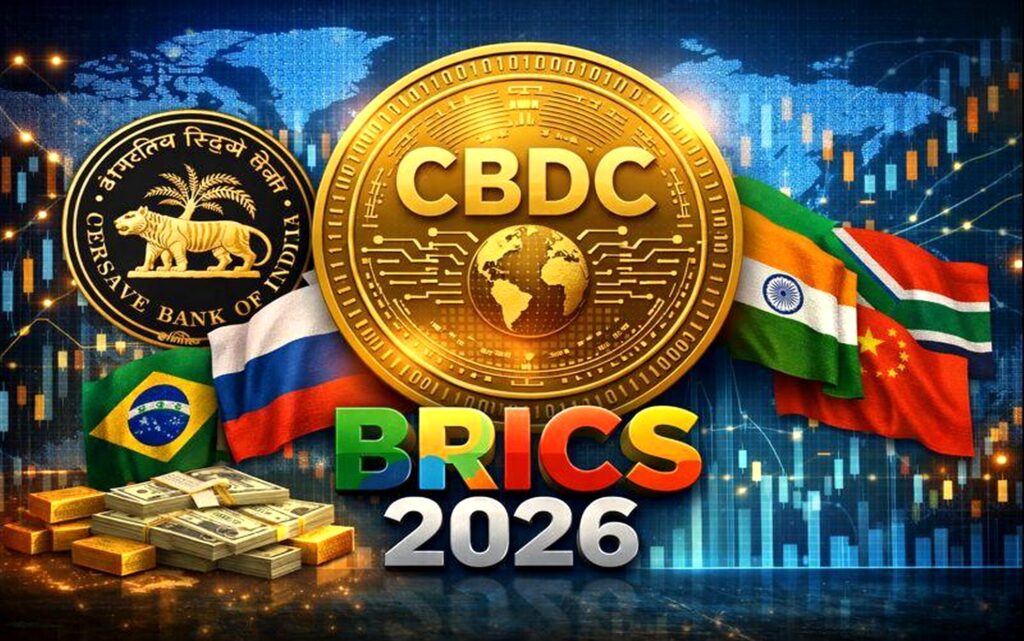
BRICS countries are accelerating work on a cross-border payments architecture modeled on Brazil’s PIX system, aiming to enable direct settlements between member states using central bank digital currencies (CBDCs), reducing reliance on the US dollar and Western-controlled financial intermediaries.
The initiative envisions a unified interoperability layer connecting national digital payment infrastructures, allowing central banks to transact directly in their own sovereign digital currencies.
Instead of routing payments through correspondent banking networks or converting through the dollar, transactions would be settled instantly between domestic CBDC systems with automatic currency conversion at the protocol level.
India, set to host the 18th BRICS Summit in 2026, has placed the issue among its top financial priorities.
The Reserve Bank of India has been among the key proponents of a shared settlement mechanism within the bloc, framing it as an evolution of existing trends toward de-dollarization already visible in intra-BRICS trade.
At present, China and India conduct roughly 80% of bilateral trade in local currencies, while overall intra-BRICS trade settled without the dollar is estimated at around 65%.
The proposed system is not designed as a single common currency, but rather as a decentralized network of sovereign digital currencies.
This distinction is central to its political feasibility; Unlike the euro model, which requires monetary unification, the BRICS approach preserves full national control over monetary policy while linking systems through interoperable technical standards.
The architecture under discussion draws heavily on the Brazilian PIX instant payment system, which has become one of the most widely adopted real-time payment infrastructures globally.
PIX processes transactions in seconds, operates with minimal cost, and bypasses traditional intermediaries such as card networks and correspondent banks.
BRICS planners aim to replicate this efficiency at a cross-border level, effectively scaling the concept from domestic instant payments to international settlement rails.
Under the proposed model, a transaction such as Brazilian exports to India would no longer require dollar conversion.
A payment initiated in digital real could be directly matched with digital rupee liquidity through central bank coordination, with settlement occurring in real time.
This would significantly reduce transaction costs, foreign exchange exposure, and settlement delays.
China’s position is pivotal in the development of the system, as the country is the most advanced globally in CBDC deployment, with the digital yuan (e-CNY) already used in large-scale pilot programs and recording transaction volumes exceeding one trillion dollars equivalent.
China is also involved in mBridge, a multi-central bank platform initially developed with the Bank for International Settlements to test direct cross-border CBDC settlements.
While China’s technological lead offers a foundation for rapid implementation, it also introduces political sensitivity among BRICS members.
Several participants are wary of excessive dependence on the digital yuan, preferring a neutral framework where no single currency dominates.
This concern has pushed the design toward a multi-sovereign structure rather than a yuan-centered network.
The BRICS Payment Task Force has already made progress on defining interoperability standards between CBDC systems.
The 2025 Rio Summit declaration identified the creation of a cross-border payment framework as a strategic priority and tasked finance ministries and central banks with advancing technical and regulatory coordination.
Discussions have focused on messaging standards, settlement finality rules, and foreign exchange conversion mechanisms within a unified digital protocol layer.
A major driver behind the initiative is the bloc’s broader push to reduce structural dependence on dollar-based systems.
Together, BRICS economies account for roughly 30% of global GDP and a significant share of international trade flows.
However, much of this trade still passes through dollar-denominated clearing systems, particularly SWIFT-linked infrastructure, which remains central to global banking and can be affected by sanctions regimes.
Countries such as Russia and Iran, which have faced extensive financial restrictions, view alternative payment systems as essential for maintaining access to international markets.
For them, a CBDC-based BRICS settlement network isn’t only a matter of efficiency but also financial resilience and geopolitical autonomy.
For Brazil and other emerging economies, the potential benefits are largely technical and cost-related. Multi-step currency conversions currently impose significant spreads and fees on trade within the bloc.
A direct settlement layer could reduce these costs, improve liquidity efficiency, and lower exposure to dollar fluctuations in commodity pricing and trade finance.
Despite momentum, major structural challenges remain; Liquidity fragmentation among member currencies is one of the most significant obstacles.
Outside the yuan, most BRICS currencies have limited international depth, making large-scale direct conversion between them difficult without a reference anchor currency.
Solving this requires either advanced liquidity pooling mechanisms or synthetic settlement units, both of which are still under discussion.
Regulatory divergence also poses a barrier, as BRICS members operate under different financial regimes, capital controls, and levels of central bank autonomy.
Achieving interoperability requires alignment on compliance standards, cybersecurity protocols, and monetary settlement rules, which will likely take multiple negotiation cycles.
Even so, the direction of travel is becoming clearer; The increasing share of intra-BRICS trade settled in local currencies, combined with rapid CBDC development in several member states, has created conditions for a parallel financial infrastructure.
The planned discussions at the 2026 summit in India are expected to focus less on conceptual design and more on pilot integration pathways between existing national systems.
If implemented, the system would represent one of the most significant shifts in international payments architecture in decades, gradually reshaping how trade is settled among some of the world’s largest emerging economies and reducing the structural dominance of dollar-based clearing in selected corridors.