The New York Times: How is Iran preparing for a possible US strike?
The New York Times published an analytical article detailing Iran’s interior and Tehran’s preparations for a possible US strike.
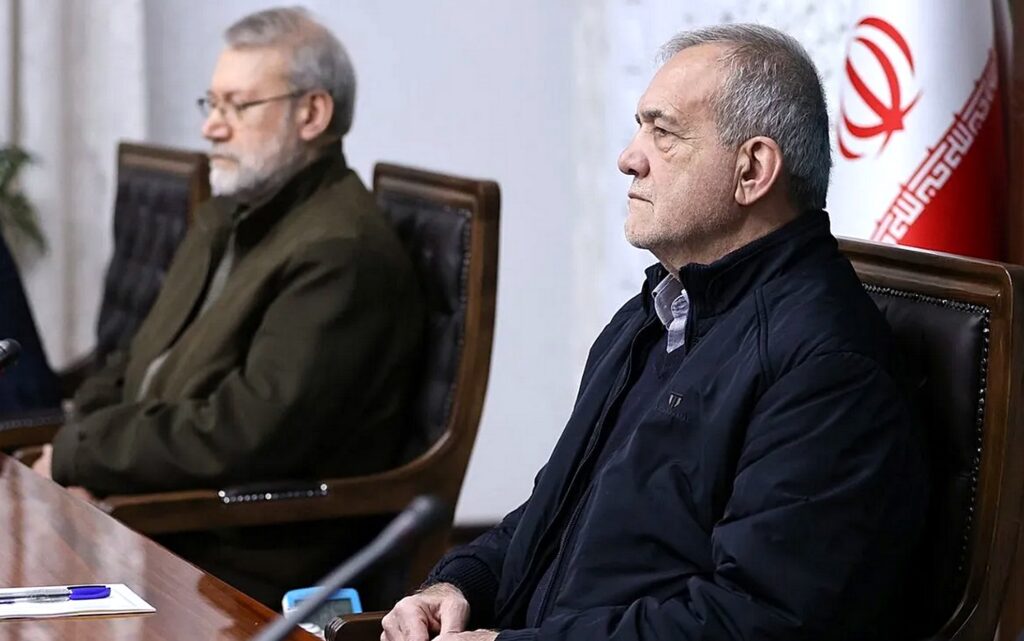
In early January, when Iran faced nationwide protests and threats of strikes by the United States, the country’s Supreme Leader Ayatollah Ali Khamenei turned to a trusted and loyal aide to Ali Larijani, the country’s top national security official, to guide the country.
Since then, Ali Larijani, a veteran politician, former commander of the Revolutionary Guards and now head of the Supreme National Security Council, has effectively run the country’s affairs.
His rise sidelined President Masoud Pezeshkian, a professional heart surgeon, who has become a senior politician, has had a challenging year in office, and still openly declares that he is a doctor, not a politician, and that no one should expect him to solve Iran’s many problems.
This account of Larijani’s rise and the decisions and deliberations of the Iranian leadership in light of the Trump administration’s threats of war is based on interviews with six high-ranking Iranian officials, one of whom is affiliated with Ayatollah Khamenei’s office, three members of the Revolutionary Guards, former Iranian diplomats, and reports from Iranian media.
Officials and members of the Revolutionary Guards spoke on condition of anonymity to discuss internal government affairs frankly.
According to the sources, Larijani’s responsibilities have steadily increased over the past few months, as he has been responsible for repelling the recent protests with the use of force, and is currently working to rein in the opposition, coordinate with powerful allies and regional actors, and oversee nuclear negotiations with Washington.
He is also drawing up plans to manage relations with Iran during a potential war with the United States as Washington builds up its forces in the region.
Larijani said in a media interview during a visit to the Qatari capital Doha this month: “We’re ready in our country… We’re certainly stronger than we were before… We’ve been preparing for the last seven or eight months… We discovered our weaknesses and addressed them… We’re not in a war and we won’t start it, but if they impose it on us, we will respond”.
Ayatollah Khamenei instructed Larijani and a few other political and military cronies to ensure the Islamic Republic’s survival not only in the face of US and Israeli bombs, but also in the face of any assassination attempts targeting its top leadership, including the assassination of Ayatollah Khamenei himself, according to six senior officials and members of the Revolutionary Guards.
According to six senior officials and members of the Revolutionary Guards, Ayatollah Khamenei issued a series of directives, setting out four levels of succession to each of the military and government leadership positions he appointed.
Khamenei also ordered all those in leadership positions to nominate up to four replacements, and delegated responsibilities to a narrow circle of confidants to make decisions in the event of a loss of communication or his assassination.
During his disappearance last June during the 12-day war with Israel, Ayatollah Khamenei nominated three candidates to succeed him whose identities he never publicly disclosed.
But Larijani is almost certainly not among them because he isn’t a senior Shiite cleric, a prerequisite for any successor, but Larijani enjoys a prominent position within Ayatollah Khamenei’s inner circle.
This department includes his chief military adviser and former commander-in-chief of the Islamic Revolutionary Guard Corps (IRGC), Major General Yahya Rahim Safavi, former IRGC commander and current speaker of parliament, Brigadier General Mohammad Baqer Qalibaf, who was appointed by Ayatollah Khamenei as his de facto deputy to command the armed forces during the war, and his chief of staff, cleric Ali Asghar Hijazi.
Part of this planning is due to the lessons learned from Israel’s surprise attack in June, which wiped out Iran’s top military command in the early hours of the war.
After the ceasefire, Ayatollah Khamenei appointed Larijani as secretary of the National Security Council and established a new National Defense Council, headed by Admiral Ali Shamkhani, to manage wartime military affairs.
Six officials and three members of Iran’s Islamic Revolutionary Guard Corps (IRGC) said Iran was operating on the assumption that US military strikes were inevitable and imminent, even as the two sides continued diplomatic dialogue and negotiations on the nuclear deal.
They added that Iran has raised the state of maximum alert in all its armed forces and is preparing for fierce resistance.
Three members of the Revolutionary Guards and four senior officials said the country was deploying ballistic missile launchers along its western border with Iraq close enough to strike Israel and along its southern shores on the Gulf, within range of US military bases and other targets in the region.
Over the past few weeks, Iran has periodically closed its airspace for missile tests, conducted military exercises in the Gulf, and briefly closed the Strait of Hormuz, a vital waterway for global energy supplies.
Meanwhile, Ayatollah Khamenei has maintained a defiant front, saying in a speech last week that the world’s most powerful army may receive a strong blow that will render it unable to rise and threatening to sink US warships assembled in nearby waters.
In the event of war, units of police special forces, intelligence operatives and battalions of the Revolutionary Guards’ Basij will be deployed on the streets of major cities, according to three Revolutionary Guards members and two senior officials.
The Basij brigades will set up checkpoints to prevent internal unrest and search for agents linked to foreign spy agencies.
The Iranian leadership’s preparations include not only military and security mobilization, but also ensuring its political survival.
The deliberations, described by six officials familiar with the planning, address a range of issues, including who will run the country in the event of the death of Ayatollah Khamenei and senior officials.
According to the New York Times, the leaders considered who could be “the Delcy of Iran” referring to Delcy Rodríguez, the Venezuelan vice president who struck a deal with the Trump administration to run Venezuela after the arrest of its president, Nicolas Maduro.
The three officials pointed out that Larijani topped the list, followed by General Qalibaf, the speaker of parliament.
Surprisingly, former President Hassan Rouhani, who has been largely excluded from Ayatollah Khamenei’s circle, is also on the list.
In addition, the New York Times indicated that Larijani’s appearance increased significantly over the past month, while President Pezhshkian’s appearance declined.
Larijani has traveled to Moscow and met with Middle Eastern leaders between meetings with US and Iranian nuclear negotiators, conducted lengthy television interviews with Iranian and foreign media outlets more than the president himself, and regularly posts content on social media, such as photos of himself taking selfies with Iranians, visiting a religious shrine, and waving his hand through the door of the plane.
According to the same source, President Pezhshkian appears to have succumbed to the delegation of power to Larijani, and Iranian media reported that the president told a cabinet meeting that he had proposed to Larijani to lift the restrictions on the internet because it harms e-commerce, a shocking admission that the president himself had to appeal to Larijani to get things done.
In January, in the midst of the crackdown on protests, US Middle East envoy Steve Witkoff tried to reach out to Iranian Foreign Minister Abbas Araghchi, according to two senior Iranian officials and a former diplomat.
President Trump has said he would strike Iran if it executes any protesters, and Witkoff was seeking to meet with Araghchi to inquire whether there were plans to carry out executions or if they had been canceled, according to the sources.
To avoid any misunderstanding, the two senior officials said that Araghchi called the Iranian president to ask if he could contact Witkoff, to which Pezhshkian replied that he didn’t know and asked him to call Ali Larijani for permission!