Cementing Conservative Dominance… Japan’s first female prime minister secures resounding mandate in Japan’s general election
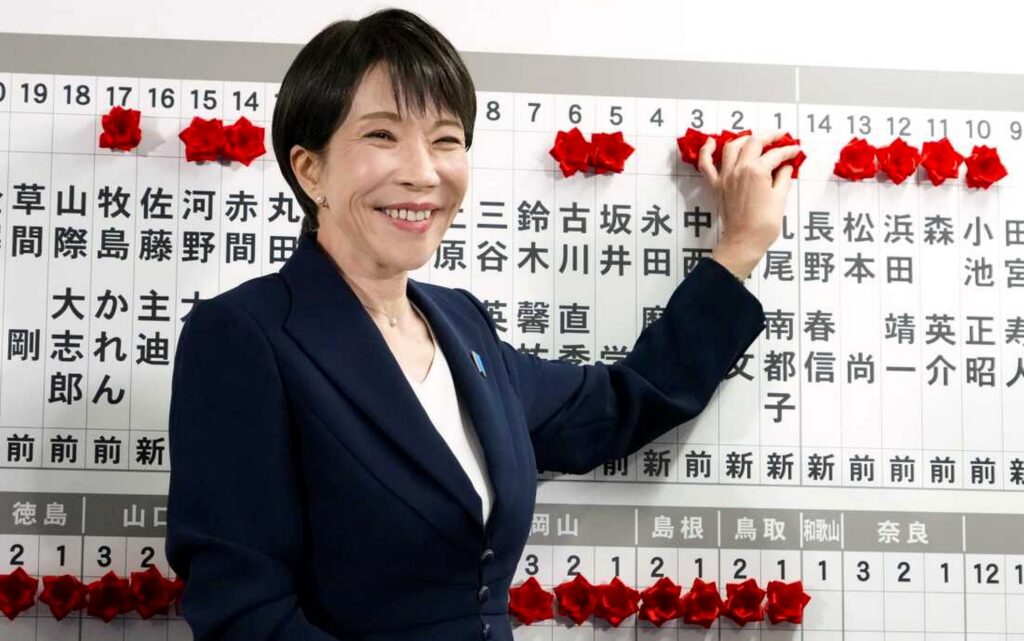
Prime Minister Sanae Takaichi has secured a decisive victory in Japan’s snap general election, delivering a commanding mandate to the ruling Liberal Democratic Party (LDP) and consolidating conservative control of the country’s lower house.
The outcome marks one of the strongest performances by a governing party in recent decades and significantly strengthens Takaichi’s political authority.
Preliminary results show the LDP winning a clear majority of seats in the 465-member House of Representatives, comfortably surpassing the threshold required to govern and approaching a two-thirds supermajority with coalition support.
The scale of the victory enables the prime minister to advance key legislative priorities with limited obstruction from opposition forces.
The election was called amid economic uncertainty, rising living costs, and intensifying regional security concerns.
Takaichi framed the vote as a referendum on stability, economic revitalization, and a more assertive national security posture.
Voters responded with strong support across multiple regions, reinforcing the LDP’s dominance in both urban and rural districts.
In her victory address, Takaichi pledged to accelerate economic reforms aimed at stimulating growth and easing household pressures.
Central proposals include targeted tax relief, expanded support for families, and measures designed to strengthen domestic industry and technological competitiveness.
The government is also expected to continue efforts to bolster supply chain resilience and reduce dependence on external markets in critical sectors.
National security featured prominently in the campaign; Takaichi reiterated her commitment to enhancing Japan’s defense capabilities and deepening strategic coordination with key allies.
Her administration has signaled readiness to revisit constitutional interpretations concerning collective self-defense, a long-standing and sensitive issue in Japanese politics.
With a strengthened parliamentary position, constitutional debate may gain renewed momentum.
The opposition, fragmented and weakened by internal divisions, struggled to present a unified alternative.
Several parties suffered significant seat losses, prompting calls within their ranks for leadership changes and strategic reassessment.
Analysts suggest that without consolidation, opposition forces will face difficulty mounting an effective challenge in future elections.
International reactions were swift, as leaders from allied nations congratulated Takaichi and reaffirmed commitments to cooperation on security and economic initiatives.
Regional observers are closely monitoring how Japan’s evolving defense and foreign policy approach may influence broader dynamics in East Asia.
Financial markets responded positively in the immediate aftermath of the vote, with equities posting gains amid expectations of policy continuity and fiscal stimulus.
Economists, however, caution that expanded spending and tax reductions will need careful management given Japan’s high public debt and demographic pressures.
The election result positions Takaichi to shape Japan’s domestic and international trajectory for the coming years, with a reinforced mandate and parliamentary leverage,
her administration now faces the task of translating electoral momentum into tangible policy outcomes while balancing fiscal responsibility, regional stability, and long-term economic reform.