G7 supports Ukraine without Trump!
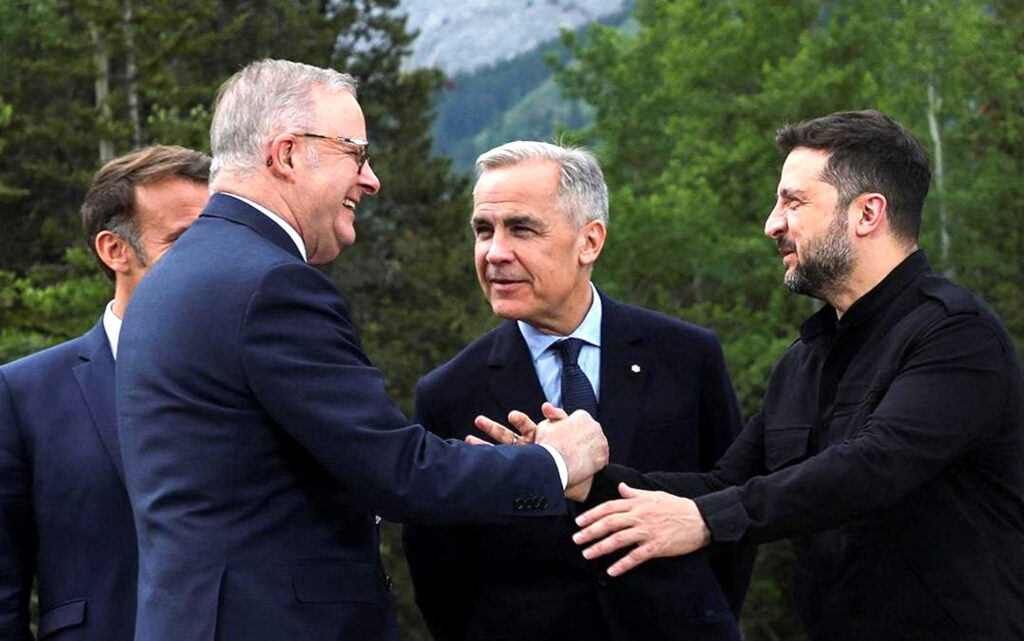
The G7 summit, which concluded on Tuesday, focused on aid to Ukraine, which was overshadowed by US President Donald Trump’s abrupt departure on Monday, to focus on the conflict between Israel and Iran.
On Monday, leaders of the Group of Seven major industrialized nations called for de-escalation in the conflict between Iran and Israel, and in the Middle East in general.
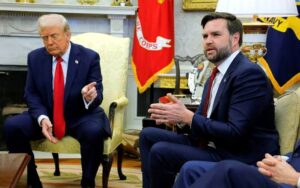
Trump left the meeting early, stressing that his decision wasn’t related to efforts to reach a ceasefire between the two hostile countries.
With Trump’s early departure, the scheduled bilateral meeting with Ukrainian President Volodymyr Zelensky was effectively canceled.
European leaders were not given the opportunity to convince him of the need to tighten sanctions on Russia.
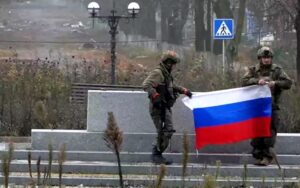
Zelensky arrived in Kananaskis, in the Canadian Rockies, where the summit is being hosted, as Kyiv suffered one of the most violent bombings since the Russian invasion of his country in February 2022, killing at least 14 people in the capital.
The Ukrainian president considered the Russian attack to demonstrate the need for additional support from his country’s allies.
“It’s important for our soldiers to be strong on the battlefield, and to remain strong until Russia is ready for peace negotiations,” he said, adding, “We’re ready for peace negotiations, for an unconditional ceasefire… To achieve this, we need to exert pressure on Russia”.
On the final day of the summit, Canadian Prime Minister Mark Carney announced that his country would provide Ukraine with €1.27 billion in new military aid, including drones and armored vehicles.
He stressed the importance of showing solidarity with Ukraine, and exerting maximum pressure on Russia, which has refused to sit at the negotiating table.
Carney also announced a new $2.3 billion loan to Ukraine to help rebuild its infrastructure.
Ottawa joined London in tightening sanctions on Russia’s ghost ship fleet used to circumvent international sanctions on its oil sales.
British Prime Minister Keir Starmer said, “These sanctions strike directly at the heart of Putin’s war machine, aiming to stifle his ability to continue his brutal war in Ukraine”.
On Monday, the US president made no secret of his skepticism about the possibility of imposing new sanctions on Moscow.
“Sanctions aren’t that easy,” he said, stressing that any new measures would have a huge cost for the United States as well.
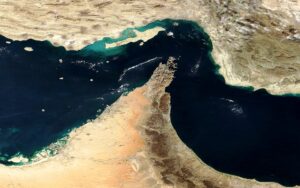
On the other hand, the US president’s departure heightens uncertainty regarding the military confrontation between Israel and Iran, which has dominated discussions among the leaders of the G7 countries—Germany, the United Kingdom, Canada, the United States, and France—as well as Italy and Japan.
Prior to the US President’s departure, the rest of the G7 leaders issued a joint statement calling for “de-escalation” and affirming Israel’s right “to defend itself”.
The declaration stated, “Iran is the primary source of instability and terrorism in the region… We’ve always made clear that Iran will never possess a nuclear weapon”.
In this joint declaration, the heads of state also called for the “protection of civilians”.
In an indication of divisions within the G7, Trump strongly attacked his French counterpart, Emmanuel Macron, accusing him of misrepresenting the reason for his departure from the summit, saying that he did so to work towards a ceasefire between Israel and Iran.
Trump wrote on Truth Social, “French President Emmanuel Macron, a self-promoting personality, incorrectly stated that I left the G7 summit in Canada to return to Washington to work on a ceasefire between Israel and Iran”.
He added, “This is wrong! He has no idea why I returned to Washington, but it certainly has nothing to do with the ceasefire. It’s much bigger than that… Emmanuel always gets it wrong… Follow me!”
Macron told reporters on the sidelines of the summit that “a proposal has been made by the Americans for a meeting… with the Iranians,” adding, “If the United States succeeds in obtaining a ceasefire, that would be good”.
As usual, the US President sent conflicting signals, as he indicated on Monday that an “agreement” would be sought regarding the conflict between Iran and Israel.
He then wrote on his Truth Social network that everyone must evacuate Tehran immediately.
While there is widespread speculation about possible direct US participation in the unprecedented Israeli air campaign, the White House reiterated that US forces remain in a defensive posture in the Middle East.
The goal of many of the leaders present was to defuse the trade war that Donald Trump has been waging since he imposed a minimum 10% tariff on most US imports and threatened to increase it.
However, the US President’s statements on his way back to Washington caused disappointment, as he didn’t hesitate to direct harsh criticism at the G7 leaders, despite the fact that the discussions during the summit were friendly.
He expressed regret that the Europeans “aren’t proposing a fair agreement at the present time” to ease the trade war with the United States.
“Either we find a good deal, or they will pay whatever we tell them to pay,” he said.
During the summit, Trump and British Prime Minister Keir Starmer confirmed the broad outlines of the trade agreement they reached in May.
For their part, the Canadians confirmed that Ottawa and Washington had pledged to reach an agreement within 30 days.
European Commission President Ursula von der Leyen said via Twitter after meeting with Trump that the US and EU administration teams “will accelerate work to reach a fair and good trade agreement”.