Financial Times: Armed groups in Venezuela pose a threat to Washington’s plans
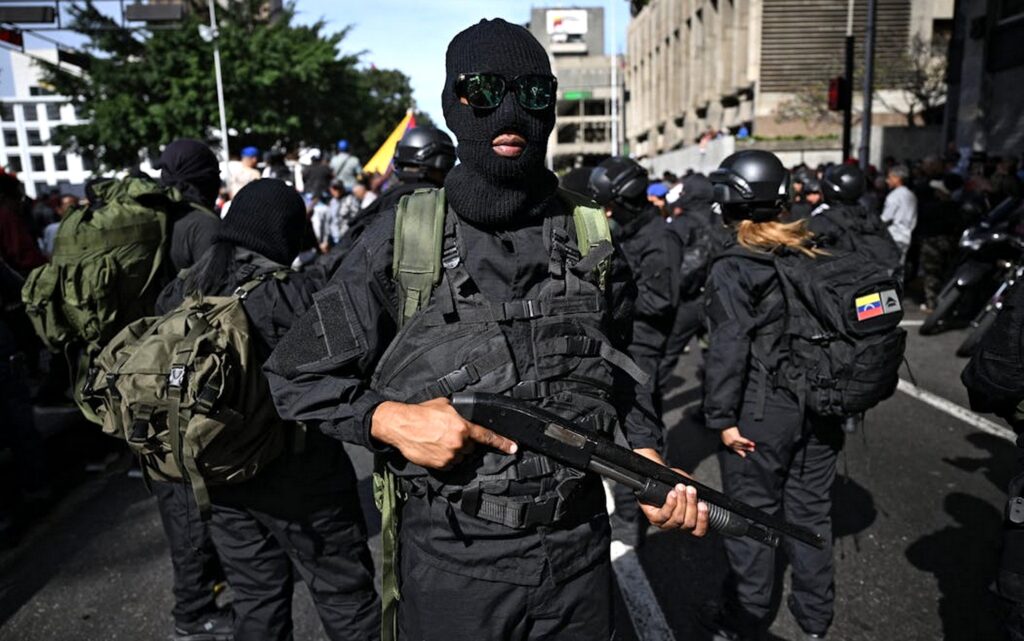
Venezuela is witnessing a widespread presence of overlapping armed groups, in a highly complex security landscape that threatens any potential transition path, and at the same time represents a major challenge to US plans to manage the country or attract foreign investment, particularly in the energy and mining sectors.
A report published by the Financial Times reviewed the security and political challenges facing Venezuelan acting President Delcy Rodriguez in dealing with armed gangs on the one hand, and controlling her relationship with army officers under US pressure, on the other.
Rodriguez doesn’t have enough power to impose her control over the armed groups in the country, noting that these formations aren’t directly under her control and operate according to their own interests.
According Andre Serbin Pont, a military analyst and head of the Crisis research center in Buenos Aires, said that armed groups are capable of sabotaging any peaceful transition process by destabilizing security and creating a state of general chaos.
The report highlighted the military actors in the Venezuelan scene, foremost among them the “Colectivos” groups, whose roots go back to the era of the late President Hugo Chavez.
These groups were initially established as local intermediaries between the state and society, but they have gradually transformed into an armed tool of repression in the hands of the regime, and their leaders publicly assert that they are the first line of defense for the revolution.
In an attempt to contain the deteriorating security situation, Rodriguez resorted to deploying members of the “Colectivos” who set up roadblocks around the capital, Caracas, and conducted searches of citizens’ phones looking for any signs of espionage, according to the report.
Outside the major cities, where effective government control is lacking, Colombian rebel groups operate along the country’s more than 2,200-kilometer border with Colombia.
According to the report, these groups run illegal gold mines in the south of the country, near the Orinoco oil belt.
The Financial Times quoted experts warning that any US military action in southern Venezuela would face fierce resistance from experienced armed groups in the region, posing a significant risk to foreign investment, particularly in oil and mining.
The National Liberation Army (ELN) stands out among these organizations; A Marxist group with between 4,000 and 6,000 fighters, it’s designated a terrorist organization by the United States.
Analysts describe it as a well-organized and experienced military force that has thus far operated in Venezuela as a quasi-ally of the regime.
The biggest challenge facing Rodriguez, remains winning the loyalty of the most prominent anti-American hardliners within the government.
Carlos Arturo Villandea, a former commander in the National Liberation Army and a conflict analyst, said that in the event of a split within the Venezuelan government, the organization would side with the radical anti-imperialist wing, according to the report.
In addition to the rebels, the Financial Times confirmed that local criminal gangs known as systems are active in the cities and have close ties to local and national politicians.
This scenario intersects with the role of the armed forces, which analysts describe as divided, weak, and deeply involved in illicit activities, from drug trafficking to the control of illegal mines, according to the report.
According to the Financial Times, Rodriguez’s biggest challenge remains winning the loyalty of the most prominent anti-American hardliners within the government, most notably Interior Minister Diosdado Cabello, who controls the police and militias, and Defense Minister Vladimir Padrino, who controls the army.
Meanwhile, Rodriguez is walking a tightrope, as she cannot reach any understanding with Washington without the approval of those who effectively control the weapons, namely Cabello and Padrino.
The Financial Times pointed out that there is a political divide even between these two leaders, warning that any sharp rift between the civilian and military wings could push Venezuela towards a widespread chaotic scenario.