Germany plans to deploy the Israeli made Arrow 3 missile defense system
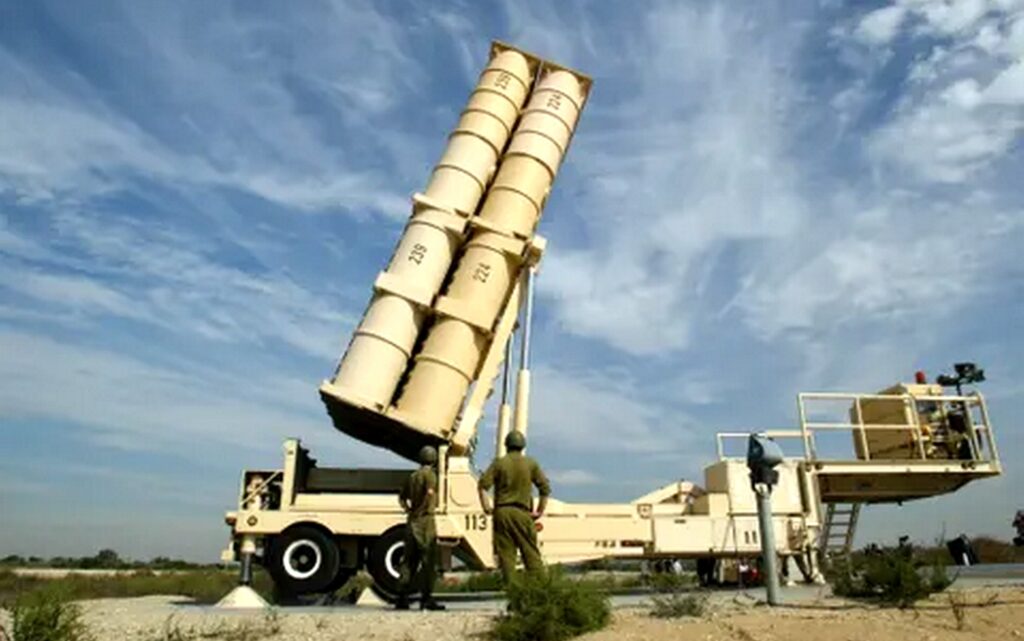
The German Air Force said on Tuesday that Inspector General Carsten Breuer and Air Force Inspector General Holger Neumann will announce on December 3 at Holzdorf Air Base in the Schönwalde region the start of the initial operational capability of the Arrow 3 missile defense system.
For the first time, the missile system will give Germany the ability to detect and intercept ballistic missiles coming from outside the Earth’s atmosphere.
Germany’s acquisition of the Israeli-made system is part of Germany’s response to the threat posed by Russia.
The Arrow aims to fill a critical gap in missile defense, as it can destroy incoming missiles at altitudes of more than 100 kilometers, allowing threats to be neutralized in the upper layers of the atmosphere and in close space, a capability that wasn’t available before.
Germany is increasing its investment in air defense, with the government launching the European Sky Shield initiative to develop a continental missile defense network in response to Russia’s war in Ukraine.
The Holzdorf base, located south of Berlin near the borders of the states of Brandenburg, Saxony-Anhalt and Saxony, is the first of three planned sites for the deployment of the Arrow system in Germany.
In related context, a poll showed that a majority of German citizens oppose their country taking a leading military role in Europe.
The poll, conducted by the Forsa Institute for Measuring Opinion Indicators commissioned by the German Kurber Foundation, revealed that 61% of respondents answered somewhat no when asked whether Germany should play this role, while 38% supported the idea.
The rejection rate in East Germany was 75% compared to 58% in the West.
The poll was conducted between September 15 and 26 with the participation of 1,503 eligible voters in Germany.
The poll examined public attitudes towards key issues in foreign and security policy.
Around 76% of them reported that they had a high or very high interest in these topics.
Germans are divided on whether their country should take greater responsibility in international crises or take a more cautious approach, as 48% supported greater engagement, while 43% favored reservation.
In the West, 51% supported a more active role, while in the East, only 35% supported it.
If Germany decides to strengthen its role, most participants prefer diplomacy to military action.
In West Germany, 71% supported a stronger diplomatic presence, while in the East the percentage rose to 84%.
Support for increased military engagement was 19% in the West and 7% in the East.
Germans’ perception of the United States has deteriorated significantly since US President Donald Trump took office in January, with nearly three-quarters (73%) of respondents describing relations between the two countries as bad.
A year ago, under Joe Biden, almost the same percentage considered relations to be good.
When asked about Germany’s most important foreign policy partner, the United States came far behind France, with 26% to France’s 46%.
Despite reservations about military leadership, 72% believe it’s right for Germany to double its defense spending over the next decade, but 82% rejected the idea of Germany having its own nuclear weapons.